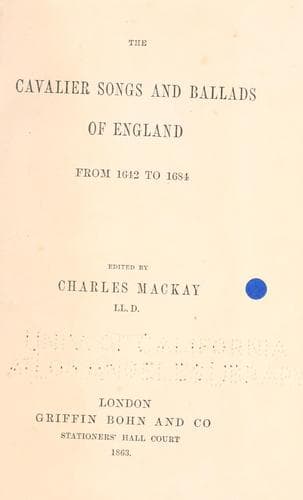
The Cavalier Songs and Ballads of England from 1642 to 1684
History
The Cavalier Songs and Ballads of England from 1642 to 1684
Ballads, English; English poetry -- Early modern, 1500-1700
To the Queen, quothiwell; Drink it off, says Nell,
They say she is wondrous pretty;
And the prince, says Hugh; That’s right, says Sue;
God send him home, says Katy;
May the powers above this tribe remove,
And send us back the man we love.
Huzza! they cried; Huzza! they all replied,
God bless our noble King.
The liquor spent, they to dancing went,
Each gamester took his mate;
Ralph bow’d to Moll, and Hodge to Doll,
Hal took out black-eyed Kate.
Name your dance, quoth John; Bid him, says Anne,
Play, The King shall enjoy his own again.
Huzza! they cried; Huzza! they all replied,
God bless our noble King.
* * * * *
THE END.
* * * * *
JOHN CHILDS AND SON, PRINTERS.
* * * * *
FOOTNOTES
{1} This stanza is omitted in most collections. Walker was a colonel in
the parliamentary army; and afterwards a member of the Committee of
Safety.
{2} The Directory for the Public Worship of God, ordered by the Assembly
of Divines at Westminster in 1644, to supersede the Book of Common
Prayer.
{3} The Earl of Thomond.
{4} The Excise, first introduced by the Long Parliament, was
particularly obnoxious to the Tory party. Dr Johnson more than a hundred
years later shared all the antipathy of his party to it, and in his
Dictionary defined it to be “a hateful tax levied upon commodities, and
adjudged not by the common judges of property, but by wretches hired by
those to whom excise is paid.”
{5} Henry the Eighth. The comparison is made in other ballads of the
age. To play old Harry with any one is a phrase that seems to have
originated with those who suffered by the confiscation of church
property.
{6} The Marquis of Winchester, the brave defender of his house at
Basing, had been made prisoner by Cromwell at the storming of that house
in 1645. Waller had been foiled in his attempt on this place in the year
preceding.—T. W.
{7} Sir John Ogle, one of the Royalist commanders, who was intrusted
with the defence of Winchester Castle, which he surrendered on conditions
just before the siege of Basing House.—T. W.
{8} Wren, bishop of Ely, was committed to the Tower in 1641, accused
with high “misdemeanours” in his diocese.
{9} David Jenkins, a Welsh Judge, who had been made prisoner at the
taking of Hereford, and committed first to Newgate and afterwards to the
Tower. He refused to acknowledge the authority of the Parliament, and
was the author of several tracts published during the year (while he was
prisoner in the Tower), which made a great noise.—T. W.
{10} Sir Francis Wortley, Bart., was made a prisoner in 1644, at the
taking of Walton House, near Wakefield, by Sir Thomas Fairfax.
{11} Sir Edward Hales, Bart., of Woodchurch, in Kent, had been member
for Queenborough in the Isle of Sheppey. He was not a Royalist.
Public-domain text, read in full here on John Shaqi.
Reviews
Reviews
No reviews yet
Be the first to share your thoughts on this work.
Elsewhere in the archive
Join the Discussion
Join the discussion
Sign in to leave a comment or review.
Sign InorCreate an account