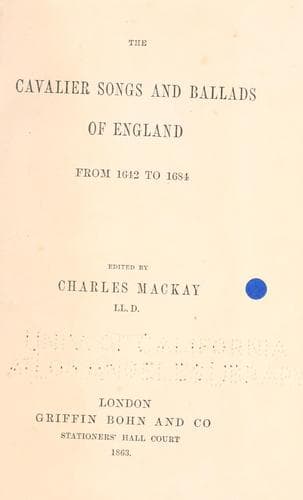
The Cavalier Songs and Ballads of England from 1642 to 1684
History
The Cavalier Songs and Ballads of England from 1642 to 1684
Ballads, English; English poetry -- Early modern, 1500-1700
{12} Sir George Strangways, Bart., according to the marginal note in the
original. Another of the name, Sir John Strangways, was taken at the
surrender of Sherborne Castle.
{13} Sir Henry Bedingfield, Bart., of Norfolk; Sir Walter Blount, Bart.,
of Worcester; and Sir Francis Howard, Bart., of the North, were committed
to the Tower on the 22nd of January, 1646.
{14} The horrible barbarities committed by the Irish rebels had made the
Catholics so much abhorred in England, that every English member of that
community was suspected of plotting the same massacres in England.—T. W.
{15} Sir John Hewet, of Huntingdonshire, was committed to the Tower on
the 28th of January, 1645(–6).
{16} Sir Thomas Lunsford, Bart., the celebrated Royalist officer, was
committed to the Tower on the 22nd of January, 1646. The violence and
barbarities which he and his troop were said to have perpetrated led to
the popular belief that he was in the habit of eating children.
From Fielding and from Vavasour,
Both ill-affected men;
From Lunsford eke dilver us,
That eateth up children.
Loyal Songs, ed. 1731, i. 38.
T. W.
{17} Sir William Lewis, one of the eleven members who had been impeached
by the army.
{18} Col. Giles Strangwaies, of Dorsetshire, taken with Sir Lewis Dives,
at the surrender of Sherborne, was committed to the Tower on the 28th
August, 1645. He was member for Bridport in the Long Parliament, and was
one of those who attended Charles’s “Mongrel” Parliament at Oxford.
{19} Sir Lewis Dives, an active Royalist, was governor of Sherborne
Castle for the King, and had been made a prisoner by Fairfax in August,
1645, when that fortress was taken by storm. He was brother-in-law to
Lord Digby.
{20} Sir John Morley, of Newcastle, committed to the Tower on the 18th
of July, 1645.
{21} King was a Royalist general, in the north, who was slain July,
1643.
{22} Sir William Morton, of Gloucestershire, committed to the Tower on
the 17th August, 1644. Cardinal Morton, Archbishop of Canterbury,
brought about the marriage between King Henry VII. and the daughter of
Edward IV., and thus effected the unison of the rival houses of York and
Lancaster.
{23} Thomas Coningsby, Esq., of Northmyus in Hertfordshire, committed to
the Tower in November, 1642, for reading the King’s commission of array
in that county.
{24} Sir Wingfield Bodenham, of the county of Rutland, committed to the
Tower on the 31st of July, 1643.
{25} Sir Henry Vaughan, a Welsh knight, committed to the Tower on the
18th July, 1645.
Public-domain text, read in full here on John Shaqi.
Reviews
Reviews
No reviews yet
Be the first to share your thoughts on this work.
Elsewhere in the archive
Join the Discussion
Join the discussion
Sign in to leave a comment or review.
Sign InorCreate an account