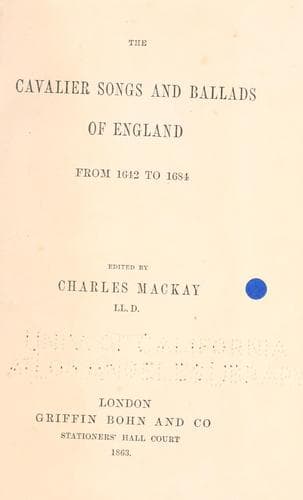
The Cavalier Songs and Ballads of England from 1642 to 1684
History
The Cavalier Songs and Ballads of England from 1642 to 1684
Ballads, English; English poetry -- Early modern, 1500-1700
{38} In the seventeenth century Lancashire enjoyed an unhappy
pre-eminence in the annals of superstition, and it was regarded
especially as a land of witches. This fame appears to have originated
partly in the execution of a number of persons in 1612, who were
pretended to have been associated together in the crime of witchcraft,
and who held their unearthly meetings at the Malkin Tower, in the forest
of Pendle. In 1613 was published an account of the trials, in a thick
pamphlet, entitled “The Wonderful Discoverie of Witches in the Countie of
Lancaster. With the Arraignment and Triall of nineteene notorious
Witches, at the Assizes and general Goale Deliverie, holden in the Castle
of Lancaster, on Monday, the seventeenth of August last, 1612. Published
and set forth by commandment of his Majesties Justices of Assize in the
North Parts, by Thomas Potts, Esquier.” “The famous History of the
Lancashire Witches” continued to be popular as a chap-book up to the
beginning of the nineteenth century.—T. WRIGHT.
{39} An allusion to the Dutch War of 1651 and 1652.
{40} Oliver Cromwell.
{41} The Welsh were frequently the subject of satirical allusions during
the civil wars and the Commonwealth.
{42} Speaker of the Long Parliament.
{43} Cromwell’s wife.
{44} Cromwell’s two sons, Richard and Henry.
{45} Cromwell’s daughter.
{46} Col. Pride, originally a brewer’s drayman.
{47} Walter Strickland, M.P. for a Cornish borough.
{48} Monk was with his troops in Scotland, but had declared himself an
approver of the proceedings of the Parliament.
{49} Dr John Owen, Joseph Caryl, and Philip Nye, were three of the most
eminent divines of this eventful age. Caryl, who was a moderate
independent, was the author of the well-known “Commentary on Job.” Dr
Owen enjoyed the especial favour of Cromwell, who made him Dean of
Christchurch, Oxford; in his youth he had shown an inclination to
Presbyterianism, but early in the war he embraced the party of the
Independents. He was a most prolific writer. Nye was also an eminent
writer: previous to 1647 he had been a zealous Presbyterian, but on the
rise of Cromwell’s influence he joined the Independents, and was employed
on several occasions by that party.—T. W.
{50} Col. John Ireton was the brother of the more celebrated Henry
Ireton, and was an alderman of London. He appears to have been clerk of
the Council of Officers at Wallingford House.
Public-domain text, read in full here on John Shaqi.
Reviews
Reviews
No reviews yet
Be the first to share your thoughts on this work.
Elsewhere in the archive
Join the Discussion
Join the discussion
Sign in to leave a comment or review.
Sign InorCreate an account