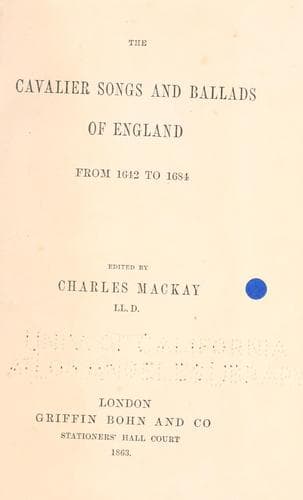
The Cavalier Songs and Ballads of England from 1642 to 1684
History
The Cavalier Songs and Ballads of England from 1642 to 1684
Ballads, English; English poetry -- Early modern, 1500-1700
{26} Lilburn was, as has been observed, in the Tower for his practices
against the present order of things, he being an advocate of extreme
democratic principles; and he was there instructed in knotty points of
law by Judge Jenkins, to enable him to torment and baffle the party in
power. It was Jenkins who said of Lilburne that “If the world were
emptied of all but John Lilburne, Lilburne would quarrel with John, and
John with Lilburne.”—T. W.
{27} Mr Thomas Violet, of London, goldsmith, committed to the Tower
January 6th, 1643(–4), for carrying a letter from the King to the mayor
and common council of London.
{28} Dr Hudson had been concerned in the King’s transactions with the
Scots, previous to his delivering himself up to them, and he and
Ashburnham had been his sole attendants in his flight from Oxford for
that purpose.—T. W.
{29} Poyntz and Massey were staunch Presbyterians, and their party
counted on their assistance in opposing the army: but they withdrew, when
the quarrel seemed to be near coming to extremities.
{30} Glynn was one of the eleven members impeached by the army.
{31} It was believed at this time that Fairfax was favourable to the
restoration of the King.
{32} The “Jack Ketch” of the day.
{33} The copy in the “Rump Songs” has “Smee and his tub.”
{34} The old proverbial expression of “the devil and his dam” was
founded on an article of popular superstition which is now obsolete. In
1598, a Welshman, or borderer, writes to Lord Burghley for leave “to
drive the devill and his dam” from the castle of Skenfrith, where they
were said to watch over hidden treasure: “The voyce of the countrey goeth
there is a dyvell and his dame, one sitts upon a hogshed of gold, the
other upon a hogshed of silver.” (Queen Elizabeth and her Times, ii.
397.) The expression is common in our earlier dramatic poets: thus
Shakespeare,—
—“I’ll have a bout with thee;
Devil, or devil’s dam, I’ll conjure thee:
Blood will I draw on thee, thou art a witch.”
(Hen. V. Part I. Act I. sc. 5.)
T. W.
{35} The prediction was not _quite_ so speedily verified.
{36} Colonel Hewson, originally a shoemaker.
{37} Newspapers.
Public-domain text, read in full here on John Shaqi.
Reviews
Reviews
No reviews yet
Be the first to share your thoughts on this work.
Elsewhere in the archive
Join the Discussion
Join the discussion
Sign in to leave a comment or review.
Sign InorCreate an account