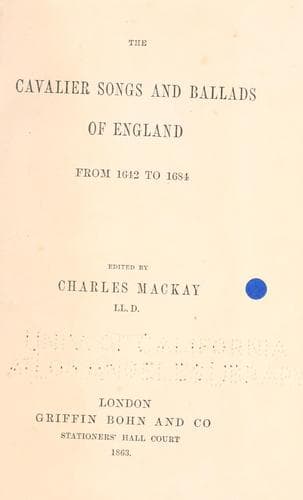
The Cavalier Songs and Ballads of England from 1642 to 1684
History
The Cavalier Songs and Ballads of England from 1642 to 1684
Ballads, English; English poetry -- Early modern, 1500-1700
{56} Pepys gives the following description of the rejoicings in the city
on the evening of the eleventh of February:—“In Cheapside there were a
great many bonfires, and Bow bells and all the bells in all the churches
as we went home were a-ringing. Hence we went homewards, it being about
ten at night. But the common joy that was everywhere to be seen! The
number of bonfires! there being fourteen between St Dunstan’s and Temple
Bar, and at Strand Bridge I could at one time tell thirty-one fires. In
King-street seven or eight; and all along burning, and roasting, and
drinking for Rumps, there being rumps tied upon sticks and carried up and
down. The butchers at the May Pole in the Strand rang a peal with their
knives when they were going to sacrifice their rump. On Ludgate Hill
there was one turning of a spit that had a rump tied upon it, and another
basting of it. Indeed it was past imagination, both the greatness and
the suddenness of it. At one end of the street you would think there was
a whole lane of fire, and so hot that we were fain to keep on the further
side.”
{57} In a satirical tract, entitled “Free Parliament Quæries,” 4to,
April 10, 1660, it is inquired “Whether Sir Arthur did not act the Raging
Turk in Westminster Hall, when he saw the admission of the secluded
members?” Pepys gives the following account of the reception of Monck’s
letter from the city on the 11th of February:—“So I went up to the lobby,
where I saw the Speaker reading of the letter; and after it was read Sir
A. Haselrigge came out very angry, and Billing, standing by the door,
took him by the arm and cried, ‘Thou man, will thy beast carry thee no
longer? thou must fall!’”
{58} Haselrigge was accused of having been a dupe to Monck’s cunning
intrigues.
{59} The celebrated Praise-God Barebone, at the head of a body of
fanatics, had (February 9th) presented a strong petition to the House in
support of the Good old Cause, which gave great offence to the
Presbyterian party and the citizens, although it was received with
thanks. According to Pepys, one of Monck’s complaints against the
Parliament was, “That the late petition of the fanatique people presented
by Barebone, for the imposing of an oath upon all sorts of people, was
received by the House with thanks.” The citizens did not omit to show
their hostility against the presenter of the petition. On the 12th,
Pepys says, “Charles Glascocke . . . told me the boys had last night
broke Barebone’s windows.” And again, on the 22nd, “I observed this day
how abominably Barebone’s windows are broke again last night.”
Public-domain text, read in full here on John Shaqi.
Reviews
Reviews
No reviews yet
Be the first to share your thoughts on this work.
Elsewhere in the archive
Join the Discussion
Join the discussion
Sign in to leave a comment or review.
Sign InorCreate an account