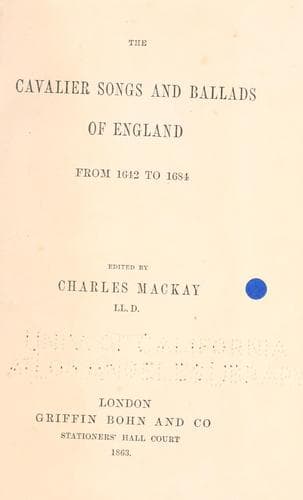
The Cavalier Songs and Ballads of England from 1642 to 1684
History
The Cavalier Songs and Ballads of England from 1642 to 1684
Ballads, English; English poetry -- Early modern, 1500-1700
{60} Miles Corbet, as well as Tichbourn, had sat upon the King in
judgment. In a satirical tract, published about the same time as the
present ballad, Tichbourn is made to say, “They say I am as notorious as
Miles Corbet the Jew.” In another, entitled “The Private Debates, etc.,
of the Rump,” 4to, April 2, 1660, we read, “Call in the Jews, cryes
Corbet, there is a certain sympathy (quoth he), methinks, between them
and me. Those wandering pedlers and I were doubtless made of the same
mould; they have all such blote-herring faces as myself, and the devil
himself is in ’um for cruelty.” He was one of those who fled on the
Restoration, but he was afterwards taken treacherously in Holland, and,
being brought to London, was executed as a regicide. In another
satirical tract, entitled “A Continuation of the Acts and Monuments of
our late Parliament” (Dec. 1659), it is stated that, “July 1, This very
day the House made two serjeants-at-law, William Steele and Miles Corbet,
and that was work enough for one day.” And, in a fourth, “Resolved, That
Miles Corbet and Robert Goodwin be freed from the trouble of the Chief
Register Office in Chancery.” _Mercurius Honestus_, No. 1. (March 21,
1659–60.)
{61} William Lord Monson, Viscount Castlemaine, was member for Ryegate
in the Long Parliament. He was degraded from his honour at the
Restoration, and was condemned to be drawn on a sledge with a rope round
his neck from the Tower to Tyburn, and back again, and to be imprisoned
there for life. It appears, by the satirical tracts of the day, that he
was chiefly famous for being beaten by his wife. In one, entitled “Your
Servant, Gentlemen,” 4to, 1659, it is asked, “Whether that member who
lives nearest the church ought not to ride Skimmington next time my Lady
Mounson cudgels her husband?” And in another (“The Rump Despairing,”
4to, London, March 26, 1660) we find the following passage:—“To my Lord
Monson. A sceptre is one thing, and a ladle is another, and though his
wife can tell how to use one, yet he is not fit to hold the other.”
{62} Pudding John, or Jack Pudding, was a proverbial expression of the
times for a Merry Andrew. In an old English-German Dictionary it is
explained thus:—“_Jack-Pudding_, un buffon de theatre, deliciæ populi,
ein Hanswurst, Pickelhering.” The term was applied as a soubriquet to
any man who played the fool to serve another person’s ends. “And first
Sir Thomas Wrothe (_Jack Pudding_ to Prideaux the post-master) had his
cue to go high, and feele the pulse of the hous.” History of
Independency, p. 69 (4to, 1648).
{63} An allusion to James Harrington’s “Oceana.”
Public-domain text, read in full here on John Shaqi.
Reviews
Reviews
No reviews yet
Be the first to share your thoughts on this work.
Elsewhere in the archive
Join the Discussion
Join the discussion
Sign in to leave a comment or review.
Sign InorCreate an account