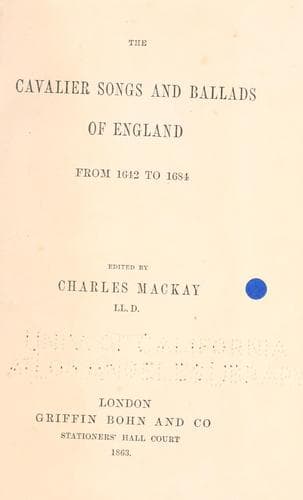
The Cavalier Songs and Ballads of England from 1642 to 1684
History
The Cavalier Songs and Ballads of England from 1642 to 1684
Ballads, English; English poetry -- Early modern, 1500-1700
And now to such a grievous height
Are our misfortunes grown,
That our estates are took away
By tricks before ne’er known.
For there are agents sent abroad
Most humbly for to crave
Our alms; but if they are denied,
And of us nothing have,
Then by a vote _ex tempore_
We are to prison sent,
Mark’d with the name of enemy,
To King and Parliament:
And during our imprisonment,
Their lawless bulls do plunder
A license to their soldiers,
Our houses for to plunder.
And if their hounds do chance to smell
A man whose fortunes are
Of some account, whose purse is full,
Which now is somewhat rare;
A _monster_ now, _delinquent_ term’d,
He is declared to be,
And that his lands, as well as goods,
Sequester’d ought to be.
As if our prisons were too good,
He is to Yarmouth sent,
By virtue of a warrant from
The King and Parliament.
Thus in our royal sovereign’s name,
And eke his power infused,
And by the virtue of the same,
He and all his abused.
For by this means his castles now
Are in the power of those
Who treach’rously, with might and main,
Do strive him to depose.
Arise, therefore, brave British men,
Fight for your King and State,
Against those trait’rous men that strive
This realm to ruinate.
’Tis Pym, ’tis Pym and his colleagues,
That did our woe engender;
Nought but their lives can end our woes,
And us in safety render.
THE MAN O’ THE MOON.
Hogg, in his second series of Jacobite Relics, states that he “got this
song among some old papers belonging to Mr Orr of Alloa,” and that he
never met with it elsewhere. In his first series he printed a Scottish
song beginning,—
“Then was a man came fron the moon
And landed in our town, sir,
And he has sworn a solemn oath
That all but knaves must down, sir.”
In Martin Parker’s foregoing ballad, “When the King enjoys his own
again,” there is also an allusion to the man in the moon:—
“The Man in the Moon
May wear out his shoon
By running after Charles his wain;”
as it would appear that the “Man in the Moon,” was the title assumed by
an almanack-maker of the time of the Commonwealth, who, like other
astronomers and astrologers, predicted the King’s restoration. In this
song the “Man o’ the Moon” clearly signifies King Charles.
The man o’ the moon for ever!
We’ll drink to him still
In a merry cup of ale,—
Here’s the man o’ the moon for ever!
The man o’ the moon, here’s to him!
How few there be that know him!
But we’ll drink to him still
In a merry cup of ale,—
The man o’ the moon, here’s to him!
Brave man o’ the moon, we hail thee,
The true heart ne’er shall fail thee;
For the day that’s gone
And the day that’s our own—
Brave man o’ the moon, we hail thee.
Public-domain text, read in full here on John Shaqi.
Reviews
Reviews
No reviews yet
Be the first to share your thoughts on this work.
Join the Discussion
Join the discussion
Sign in to leave a comment or review.
Sign InorCreate an account