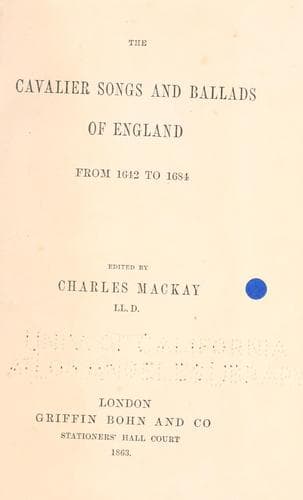
The Cavalier Songs and Ballads of England from 1642 to 1684
History
The Cavalier Songs and Ballads of England from 1642 to 1684
Ballads, English; English poetry -- Early modern, 1500-1700
{101} “October 13th. I went out to Charing Cross to see Major-General
Harrison hanged, drawn, and quartered, which was done there, he looking
as cheerful as any man could do in that condition.”—Pepys. Thomas
Harrison was the son of a butcher at Newcastle-under-Line; he conveyed
Charles I. from Windsor to Whitehall to his trial, and afterwards sat as
one of the judges.
{102} “October 15th. This morning Mr Carew was hanged and quartered at
Charing Cross; but his quarters, by a great favour, are not to be hanged
up.”—Pepys. Colonel John Carew, like Harrison, was one of the
Fifth-monarchy men, a violent and visionary but honest enthusiast.
{103} Hugh Peters, for his zeal in encouraging the Commonwealth
soldiery, was particularly hated by the Royalists. John Coke, the able
lawyer, conducted the prosecution of the King.
{104} Gregory Clement, John Jones, Thomas Scott, and Adrian Scrope, were
charged with sitting in the High Court of Justice which tried the King.
Scott was further charged with having, during the sitting of the Rump
Parliament, expressed his approbation of the sentence against the King.
Colonel Scrope, although he had been admitted to pardon, was selected as
one of the objects of vengeance, and was condemned chiefly on a reported
conversation, in which, when one person had strongly blamed what he
called the “murder” of the King, Scrope observed, “Some are of one
opinion, and some of another.”
{105} “October 19th. This morning Hacker and Axtell were hanged and
quartered, as the rest are.”—Pepys. Colonel Francis Hacker commanded the
guards at the King’s execution. Axtell was captain of the guard of the
High Court of Justice at which the King was tried.
{106} Richard Brown, one of Cromwell’s Major-generals, Governor of
Abingdon, and member for London in the Long Parliament. He had been
imprisoned by the Rump.
{107} The Earl of Norwich was George Lord Goring, who, with his son,
acted a prominent part in the Civil Wars. He was created Earl of Norwich
in 1644.
{108} John Mordaunt, son of the Earl of Peterborough, celebrated for his
exertions to raise insurrections for the King during the Protectorate,
was one of the bearers of the letters of the King to Monck. He was
created Baron Mordaunt, July 10, 1659. Charles Lord Gerard, afterwards
created Earl of Macclesfield, was a very distinguished Royalist officer.
Thomas Wentworth, Earl of Cleveland, who had suffered much for his
loyalty to Charles I., headed a body of three hundred noblemen and
gentlemen in the triumphal procession of Charles II. into London.
{109} Charles Stuart, a gallant Royalist officer, who had been created
Earl of Litchfield by Charles I. in 1645, and who immediately after the
Restoration succeeded his cousin Esme Stuart as Duke of Richmond.
Charles Stanley, Earl of Derby, was son of the Earl of Derby who was
beheaded after the battle of Worcester, and of the Countess who so
gallantly defended Latham House in 1644.
Public-domain text, read in full here on John Shaqi.
Reviews
Reviews
No reviews yet
Be the first to share your thoughts on this work.
Elsewhere in the archive
Join the Discussion
Join the discussion
Sign in to leave a comment or review.
Sign InorCreate an account