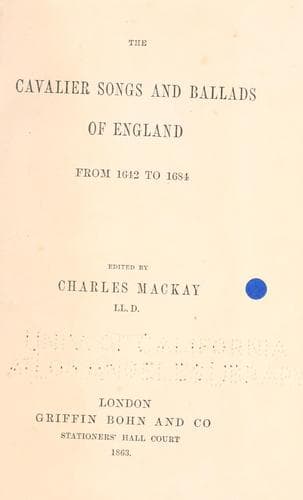
The Cavalier Songs and Ballads of England from 1642 to 1684
History
The Cavalier Songs and Ballads of England from 1642 to 1684
Ballads, English; English poetry -- Early modern, 1500-1700
{88} In the satirical tract entitled “England’s Confusion,” this member
is described as “hastily rich Cornelius Holland.” He appears to have
risen from a low station, and is characterized in the songs of the day as
having been a link-bearer.—T. W.
{89} Major Salwey was an officer in the Parliamentary array. On the
17th January, 1660, he incurred the displeasure of the House, and was
sequestered from his seat and sent to the Tower. He is described as “a
smart, prating apprentice, newly set for himself.” He appears to have
been originally a grocer and tobacconist; a ballad of the time speaks of
him as,
“Salloway with tobacco
Inspired, turned State quack-o;
And got more by his feigned zeal
Then by his, _What d’ye lack-o_?”
In another he is introduced thus,
“The tobacco-man Salway, with a heart tall of gall
Puffs down bells, steeples, priests, churches and all,
As old superstitions relicks of Baal.”
A third ballad, alluding to his attitude in the House, couples together
“Mr William Lilly’s astrological lyes,
And the meditations of Salloway biting his thumbs.”—T. W.
{90} Roger Hill was member for Bridport, in Dorsetshire. He bought a
grant of the Bishop of Winchester’s manor of Taunton Dean, valued at 1200
pounds a year. A ballad written towards the end of 1659 says of him,
“Baron Hill was but a valley,
And born scarce to an alley;
But now is lord of Taunton Dean,
And thousands he can rally.”
{91} With the revival of the Long Parliament, the old Republican
feelings arose again under the denomination of the “Good old Cause.”
Innumerable pamphlets were published for and against “The Cause.” Even
Prynne, the fierce old Presbyterian, who was now turning against the
patriots, lifted up his pen against it, and published “The Republicans
and others spurious Good old Cause briefly and truly Anatomized,” 4to,
May 13, 1659.
{92} Robert Cecil, Esq., was one of the members of the Old Long
Parliament who were now brought together to form the Rump. He
represented Old Sarum, Wilts.
{93} Luke Robinson, of Pickering Lyth, in Yorkshire, was member for
Scarborough. An old ballad says of him,
“Luke Robinson, that clownado,
Though his heart be a granado,
Yet a high shoe with his hand in his poke
Is his most perfect shadow.”
{94} Sir Harry Vane.
{95} Thomas Scott was member for Aylesbury, in Buckinghamshire, in the
Long Parliament.
{96} Hugh Peters, the celebrated fanatic. In the margin of the
original, opposite to the words “the Devil’s fees,” is the following
note—“His numps and his kidneys.”—T. W.
{97} To save his tithe pig:—probably the origin of the well known slang
phrase of the present day.
{98} Coloured, or dyed.
{99} Faustus.
{100} An allusion to a popular old story and song. A copy of the words
and tune of “The Fryar and the Nun” is preserved in the valuable
collection of ballads in the possession of Mr Thorpe of Piccadilly.—T.
W.
Public-domain text, read in full here on John Shaqi.
Reviews
Reviews
No reviews yet
Be the first to share your thoughts on this work.
Elsewhere in the archive
Join the Discussion
Join the discussion
Sign in to leave a comment or review.
Sign InorCreate an account