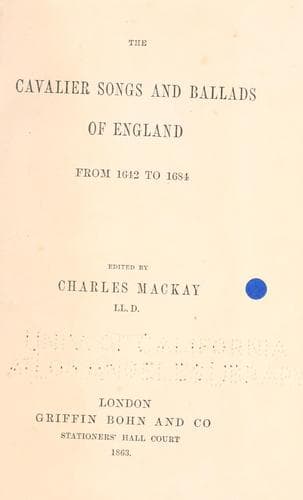
The Cavalier Songs and Ballads of England from 1642 to 1684
History
The Cavalier Songs and Ballads of England from 1642 to 1684
Ballads, English; English poetry -- Early modern, 1500-1700
the memorable period of the struggle for liberty that commenced in the
reign of Charles I. The Puritans had the pulpit on their side, and found
it a powerful instrument. The Cavaliers had the song writers on theirs,
and found them equally effective. And the song and ballad writers of
that day were not always illiterate versifiers. Some of them were the
choicest wits and most accomplished gentlemen of the nation. As they
could not reach the ears of their countrymen by the printed book, the
pamphlet, or the newspaper, nor mount the pulpit and dispute with
Puritanism on its own ground and in its own precincts, they found the
song, the ballad, and the epigram more available among a musical and
song-loving people such as the English then were, and trusted to these to
keep up the spirit of loyalty in the evil days of the royal cause, to
teach courage in adversity, and cheerfulness in all circumstances, and to
ridicule the hypocrites whom they could not shame, and the tyrants whom
they could not overthrow. Though many thousands of these have been
preserved in the King’s Pamphlets in the British Museum, and in other
collections which have been freely ransacked for the materials of the
following pages, as many thousands more have undoubtedly perished.
Originally printed as broadsides, and sold for a halfpenny at country
fairs, it used to be the fashion of the peasantry to paste them up in
cupboards, or on the backs of doors, and farmers’ wives, as well as
servant girls and farm labourers, who were able to read, would often
paste them on the lids of their trunks, as the best means of preserving
them. This is one reason why so many of them have been lost without
recovery. To Sir W. C. Trevelyan literature is indebted for the
restoration of a few of these waifs and strays, which he found pasted in
an old trunk of the days of Cromwell, and which he carefully detached and
presented to the British Museum. But a sufficient number of these flying
leaves of satire, sentiment, and loyalty have reached our time, to throw
a curious and instructive light upon the feelings of the men who resisted
the progress of the English Revolution; and who made loyalty to the
person of the monarch, even when the monarch was wrong, the first of the
civic virtues. In the superabundance of the materials at command, as
will be seen from the appended list of books and MSS. which have been
consulted and drawn upon to form this collection, the difficulty was to
keep within bounds, and to select only such specimens as merited a place
in a volume necessarily limited, by their celebrity, their wit, their
beauty, their historical interest, or the light they might happen to
throw on the obscure biography of the most remarkable actors in the
scenes which they describe. It would be too much to claim for these
ballads the exalted title of poetry. They are not poetical in the
highest sense of the word, and possibly would not have been so effective
Public-domain text, read in full here on John Shaqi.
Reviews
Reviews
No reviews yet
Be the first to share your thoughts on this work.
Join the Discussion
Join the discussion
Sign in to leave a comment or review.
Sign InorCreate an account