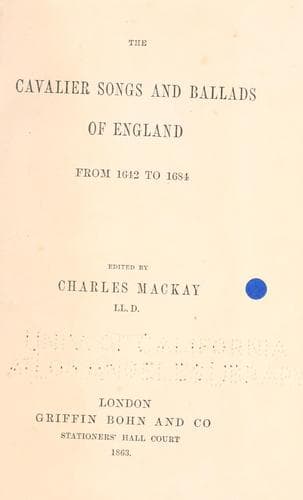
The Cavalier Songs and Ballads of England from 1642 to 1684
History
The Cavalier Songs and Ballads of England from 1642 to 1684
Ballads, English; English poetry -- Early modern, 1500-1700
Rump Collection of Songs, 1639 to 1661. _See_ Loyal Songs.
Ritson’s Ancient Songs, 1790.
,, English ,,
Ramsay, Allan, Tea-table Miscellany, 1724.
Rome rhymed to Death [qu. date].
Sportive Wit; the Muse’s Merriment [qu. date].
Skene MSS.
Suckling’s, Sir John, Works [qu. date].
Second Tale of a Tub, 1715.
Satirical Songs on Costume.
True Loyalist, or Chevalier’s Favourite, 1779.
Triumph of Wit, or Ingenuity Displayed.
Taubman’s, Mat., Heroic and Choice Songs on the Times, 1682.
Westminster Drollery, 1671.
* Wit and Mirth, or Pills to Purge Melancholy.
Wit restored, 1658.
Wit’s Recreation, 1654
Williams’, Sir Charles Hanbury, Political Songs.
Wood’s, Anthony, Collection at Oxford [Ashmolean].
Withers, George, Songs.
Wade’s, John, Ballads [qu. date].
CAVALIER SONGS AND BALLADS.
WHEN THE KING ENJOYS HIS OWN AGAIN.
This is perhaps the most popular of all the Cavalier songs—a favour which
it partly owes to the excellent melody with which it is associated. The
song, says Mr Chappell, is ascertained to be by Martin Parker, by the
following extract from the _Gossips’ Feast_, or Moral Tales, 1647. “By
my faith, Martin Parker never got a fairer treat: no, not when he indited
that sweet ballad, When the King enjoys his own again.” In the poet’s
Blind Man’s Bough (or Buff), 1641, Martin Parker says,
“Whatever yet was published by me
Was known as Martin Parker, or M. P.;”
but this song was printed without his name or initials, at a time when it
would have been dangerous to give either his own name or that of his
publisher. Ritson calls it the most famous song of any time or country.
Invented to support the declining interest of Charles I., it served
afterwards with more success to keep up the spirits of the Cavaliers, and
promote the restoration of his son; an event which it was employed to
celebrate all over the kingdom. At the Revolution of 1688, it of course
became an adherent of the exiled King, whose cause it never deserted. It
did equal service in 1715 and 1745. The tune appears to have been
originally known as _Marry me_, _marry me_, _quoth he_, _bonnie lass_.
Booker, Pond, Hammond, Rivers, Swallow, Dade, and “The Man in the Moon,”
were all astrologers and Almanac makers in the early days of the civil
war. “The Man in the Moon” appears to have been a loyalist in his
predictions. Hammond’s Almanac is called “bloody” because the compiler
always took care to note the anniversary of the death, execution, or
downfall of a Royalist.
WHAT _Booker_ doth prognosticate
Concerning kings’ or kingdoms’ fate?
I think myself to be as wise
As he that gazeth on the skies;
My skill goes beyond the depth of a _Pond_,
Or _Rivers_ in the greatest rain,
Thereby I can tell all things will be well
When the King enjoys his own again.
Public-domain text, read in full here on John Shaqi.
Reviews
Reviews
No reviews yet
Be the first to share your thoughts on this work.
Join the Discussion
Join the discussion
Sign in to leave a comment or review.
Sign InorCreate an account