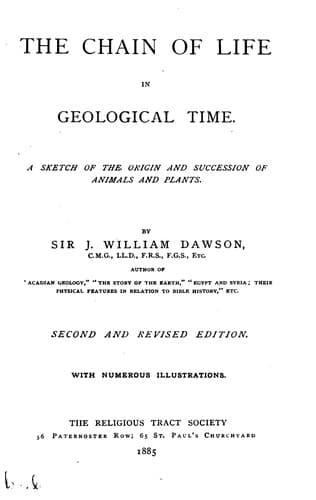
The Chain of Life in Geological Time: A Sketch of the Origin and Succession of Animals and PlantsDawson, John William, Sir
Science
The Chain of Life in Geological Time: A Sketch of the Origin and Succession of Animals and Plants
Dawson, John William, Sir
Paleobotany; Paleontology
THE CHAIN OF LIFE.
CHAPTER I.
PRELIMINARY CONSIDERATIONS AS TO THE EXTENT AND SOURCES OF OUR
KNOWLEDGE.
It is of the nature of true science to take nothing on trust or on
authority. Every fact must be established by accurate observation,
experiment, or calculation. Every law and principle must rest on
inductive argument. The apostolic motto, “Prove all things, hold fast
that which is good,” is thoroughly scientific. It is true that the mere
reader of popular science must often be content to take that on
testimony which he cannot personally verify; but it is desirable that
even the most cursory reader should fully comprehend the modes in which
facts are ascertained and the reasons on which conclusions are based.
Failing this, he loses all the benefit of his reading in so far as
training is concerned, and cannot have full assurance of that which he
believes. When, therefore, we speak of life-epochs, or of links in a
chain of living beings, the question is at once raised—What evidence
have we of the succession of such epochs? This question, with some
accessory points, must engage our attention in the present chapter.
Geology as a practical science consists of three leading parts. The
first and most elementary of these is the study of the different kinds
of rocks which enter into the composition of those parts of the earth
which are accessible to us, and which we are in the habit of calling the
crust of the earth. This is the subject of _Lithology_, which is based
on the knowledge of minerals, and has recently become a much more
precise department of science than heretofore, owing to the successful
employment of the microscope in the investigation of the minute
structure and composition of rocks. The second is the study of the
arrangement of the materials of the earth on the large scale, as beds,
veins, and irregular masses; and inasmuch as the greater part of the
rocks known to us in the earth’s crust are arranged in beds or strata,
this department may be named _Stratigraphy_. A more general name
sometimes employed is that of _Petrography_. The third division of
geology relates to the remains of animals and plants buried in the rocks
of the earth, and which have lived at the time when those rocks were in
process of formation. These fossil remains introduce us to the history
of life on the earth, and constitute the subject of _Palæontology_.
It is plain that in considering what may be learned as to epochs in the
history of life we are chiefly concerned with the last of these
divisions. The second may also be important as a means of determining
the relative ages of the fossils. With the first we have comparatively
little to do.
Public-domain text, read in full here on John Shaqi.
Reviews
Reviews
No reviews yet
Be the first to share your thoughts on this work.
Join the Discussion
Join the discussion
Sign in to leave a comment or review.
Sign InorCreate an account