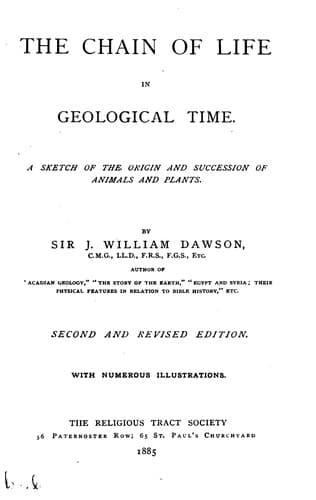
The Chain of Life in Geological Time: A Sketch of the Origin and Succession of Animals and PlantsDawson, John William, Sir
Science
The Chain of Life in Geological Time: A Sketch of the Origin and Succession of Animals and Plants
Dawson, John William, Sir
Paleobotany; Paleontology
(6) Much importance has been attached to the early works and high
culture of Egypt and Chaldæa, as evidence of vast time during which arts
were growing from a supposed rude stone age. But it must be observed
that no such period is known to antedate civilisation in the East, and
that if the early empires were established by survivors of the Deluge,
they must have brought with them the culture of Antediluvian times.
Farther, the notion of men emerging from a half-brutal state, and from
the use of the rudest implements, is purely conjectural and not
supported by facts. In America, where the semi-civilised agricultural
races are unquestionably the oldest, the rudest possible implements were
used by these partially civilised agricultural people along with
polished stone and metal; and Schliemann has shown that a rude stone age
succeeded the civilisation of Troy, and this at a time when Phœnicia and
Egypt were at the height of their civilisation. Such facts, which might
fill volumes, show how little value is to be attached to supposed ages
of rough and polished stone.
(7) The difficulties attending the establishment of geological dates for
deposits like those containing the remains of men are very great. They
are altogether superficial and local, not wide-spread marine beds in
which a distinct order of superposition can be clearly traced. They are
not easily separated from the glacial beds below, or from those above
which have been modified by human agency, by land-floods, or by
landslips. Thus the application of geological criteria of age to them is
very difficult and uncertain. Evidence of this could easily be given, in
the many errors which have been promulgated, and which have had to be
retracted by their authors, or have been disproved by the observations
of others. For example, no country was at one time richer in supposed
evidences of the antiquity of man than Scandinavia; but Professor
Torell, the director of the Geological Survey of Sweden, has recently
made a careful re-examination of the facts, and has found that there is
no evidence whatever of the existence of man in Scandinavia before the
Neolithic or polished stone age. There are, however, evidences of
considerable changes of level since that time, and it would seem even
since the twelfth century of our era. The remarkable and seemingly
inexcusable errors of observation referred to in Professor Torell’s
memoir, should enforce a caution on geologists as to the uncertainties
of such evidence. Lyell sifted the testimony bearing on this subject
with great care in the first edition of his _Antiquity of Man_. In later
editions he had to make large abatements, and now much of the evidence
in the latest edition would have to be withdrawn or otherwise applied.
Public-domain text, read in full here on John Shaqi.
Reviews
Reviews
No reviews yet
Be the first to share your thoughts on this work.
Elsewhere in the archive
Join the Discussion
Join the discussion
Sign in to leave a comment or review.
Sign InorCreate an account