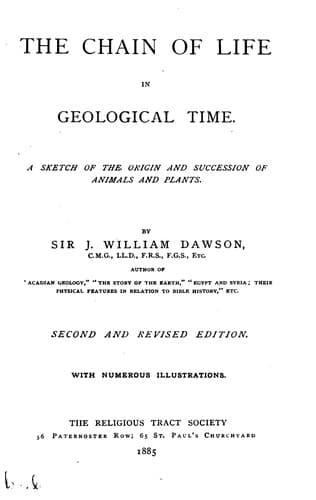
The Chain of Life in Geological Time: A Sketch of the Origin and Succession of Animals and PlantsDawson, John William, Sir
Science
The Chain of Life in Geological Time: A Sketch of the Origin and Succession of Animals and Plants
Dawson, John William, Sir
Paleobotany; Paleontology
From all these considerations the conclusion is obvious that while we
have no certain data for assigning a definite number of years to the
residence of man on the earth, we have no geological evidence for the
rash assertion often made that in comparison with historical periods the
date of the earliest races of men recedes into a dim, mysterious, and
measureless antiquity. On the basis of that Lyellian principle of the
application of modern causes to explain past changes, which is the
stable foundation of modern geology, we fail to erect any such edifice
as the indefinite antiquity of man, or to extend this comparatively
insignificant interval to an equality with the long æons of the
preceding Tertiary. The demand for such indefinite extension of the
history of man rests not on geological facts, but on the necessities of
hypotheses which, whatever their foundation, have no basis in the
discoveries of that science, and are not required to account for the
sequence which it discloses.
CHAPTER XI.
REVIEW OF THE HISTORY OF LIFE.
What general conclusions can we reach as to this long and strange
history of the progress of life on our planet? Perhaps the most
comprehensive of these is that the links in the chain of life, or rather
in its many chains, are not scattered and disunited things, but members
of a great and complex plan; and that when we discern their combinations
and their pattern, we find them not only orderly and symmetrical, but
all tending to one point and bound to one central object, even the
throne of the Eternal. It must also appear evident that the original
plan of nature, both in the animal and vegetable worlds, was too vast to
be realised at one time on a globe so limited as ours, but had to be
distributed in time as well as in space, thus realising the idea of
time-worlds: successive æons in which, one after the other, the work of
creation could rise to successive stages of perfection and completeness
till it culminated in man. All this is sufficiently plain on the
theistic view of nature, and may suffice for those who reverently regard
the God of nature as the Father of their own spirits. But there are
others who ask further questions. Do we know anything of the secondary
causes and origin of life, of the manner of its introduction and
advance, of the laws of its succession?
Public-domain text, read in full here on John Shaqi.
Reviews
Reviews
No reviews yet
Be the first to share your thoughts on this work.
Elsewhere in the archive
Join the Discussion
Join the discussion
Sign in to leave a comment or review.
Sign InorCreate an account