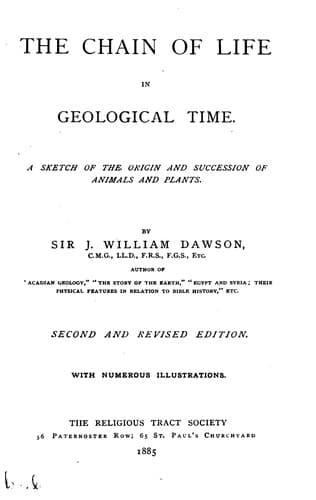
The Chain of Life in Geological Time: A Sketch of the Origin and Succession of Animals and PlantsDawson, John William, Sir
Science
The Chain of Life in Geological Time: A Sketch of the Origin and Succession of Animals and Plants
Dawson, John William, Sir
Paleobotany; Paleontology
Another allied fact is the simultaneous appearance of like types of life
in one and the same geological period, over widely separated regions of
the earth’s surface. This strikes us especially in the comparatively
simple and homogeneous life-dynasties of the Palæozoic, when for example
we find the same types of Silurian Graptolites, Trilobites and
Brachiopods appearing simultaneously in Australia, America, and Europe.
Perhaps in no department is it more impressive than in the introduction
in the Devonian and Carboniferous ages of that grand cryptogamous and
gymnospermous flora which ranges from Brazil to Spitzbergen, and from
Australia to Scotland, accompanied in all by the same groups of marine
invertebrates; or in the like wholesale production of modern types of
trees in the Cretaceous. Such facts may depend either on that long life
of specific types which gives them ample time to spread to all possible
habitats, before their extinction; or on some general law whereby the
conditions suitable to similar types of life emerge at one time in all
parts of the world. Both causes may be influential, as the one does not
exclude the other, and there is reason to believe that both are natural
facts. Should it be ultimately proved that species allied and
representative, but distinct in origin, come into being simultaneously
everywhere, we shall arrive at one of the laws of creation, and one
probably connected with the gradual change of the physical conditions of
the world.
A closely related truth is the periodicity of introduction of species.
They come in by bursts or flood-tides at particular points of time,
while these great life-waves are followed and preceded by times of ebb
in which little that is new is being produced. We labour in our
investigation of this matter under the disadvantage that the modern
period is evidently one of the times of pause in the creative work. Had
our time been that of the early Tertiary or early Mesozoic, our views as
to the question of origin of species might have been very different. It
is a striking fact, in illustration of this, that since the Glacial age
no new species of mammal can be proved to have originated on our
continents, while a great number of large and conspicuous forms have
disappeared. It is possible that the proximate or secondary causes of
the ebb and flow of life-production may be in part at least physical;
but other and more important efficient causes may be behind these. In
any case these undulations in the history of life are in harmony with
much that we see in other departments of nature.
Public-domain text, read in full here on John Shaqi.
Reviews
Reviews
No reviews yet
Be the first to share your thoughts on this work.
Elsewhere in the archive
Join the Discussion
Join the discussion
Sign in to leave a comment or review.
Sign InorCreate an account