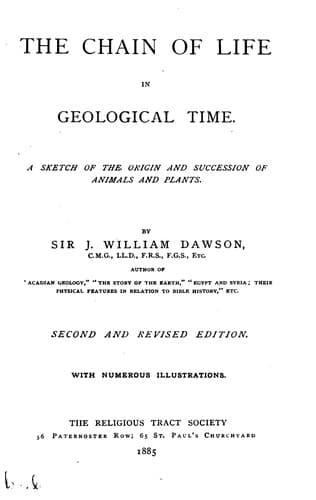
The Chain of Life in Geological Time: A Sketch of the Origin and Succession of Animals and PlantsDawson, John William, Sir
Science
The Chain of Life in Geological Time: A Sketch of the Origin and Succession of Animals and Plants
Dawson, John William, Sir
Paleobotany; Paleontology
While this unity of successive faunæ at first sight presents an
appearance of hereditary succession, it loses much of this character
when we consider the number of new types introduced without apparent
predecessors, or ceasing without successors, and the almost changeless
persistence of other types; the necessity that there should be
similarity of type in successive faunæ on any hypothesis of a continuous
plan; and, above all, the fact that the recurrence of representative
species or races in large proportion marks times of decadence rather
than of expansion in the types to which they belong. To return to a
later period, this is very manifest in that singular resemblance which
obtains between the modern mammals of South America and Australia and
their immediate fossil predecessors—the phenomenon being here
manifestly that of decadence of large and abundant species into a few
depauperated representatives. This will be found to be a very general
law, elevation being accompanied by the abrupt appearance of new types,
and decadence by the apparent continuation of old species, or
modifications of them.
This resemblance with difference in successive faunæ also connects
itself very directly with the successive elevations and depressions of
our continental plateaus in geological time.
Every great Palæozoic limestone, for example, indicates a depression
with succeeding elevation. On each elevation marine animals were driven
back into the ocean, and on each depression swarmed in over the land,
reinforced by new species, either then introduced or derived by
migration from other localities. In like manner on every depression,
land plants and animals were driven in upon insular areas, and on
re-elevation again spread themselves widely. Now I think it will be
found to be a law here that periods of expansion were eminently those of
introduction of new specific types, and periods of contraction those of
extinction, and also of continuance of old types under new varietal
forms. It must also be borne in mind that all the leading types of
invertebrate life were early introduced, that change within these was
necessarily limited, and that elevation could take place mainly by the
introduction of the vertebrate orders. So in plants, Cryptogams early
attained their maximum as well as Gymnosperms, and elevation occurred in
the introduction of Phænogams.
Public-domain text, read in full here on John Shaqi.
Reviews
Reviews
No reviews yet
Be the first to share your thoughts on this work.
Elsewhere in the archive
Join the Discussion
Join the discussion
Sign in to leave a comment or review.
Sign InorCreate an account