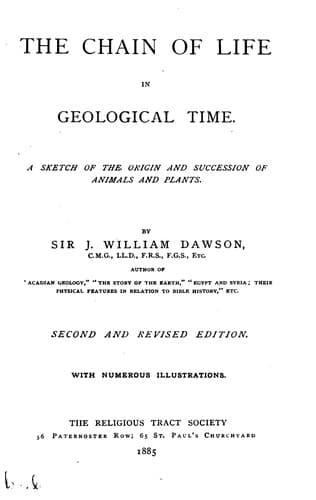
The Chain of Life in Geological Time: A Sketch of the Origin and Succession of Animals and PlantsDawson, John William, Sir
Science
The Chain of Life in Geological Time: A Sketch of the Origin and Succession of Animals and Plants
Dawson, John William, Sir
Paleobotany; Paleontology
A second aspect in which such speculations are too partial is in the
unwarranted use which they make of analogy. It is not unusual to find
such analogies as that between the embryonic development of the
individual animal and the succession of animals in geological time
placed on a level with that reasoning from analogy by which geologists
apply modern causes to explain geological formations. No claim could be
more unfounded. When the geologist studies ancient limestones built up
of the remains of corals, and then applies the phenomena of modern coral
reefs to explain their origin, he brings the latter to bear on the
former by an analogy which includes not merely the apparent results but
the causes at work, and the conditions of their action; and it is on
this that the validity of his comparison depends, in so far as it
relates to similarity of mode of formation. But when we compare the
development of an animal from an embryo cell with the progress of
animals in time, though we have a curious analogy as to the steps of the
process, the conditions and agents at work are known to be altogether
dissimilar, and therefore we have no evidence whatever as to identity of
cause, and our reasoning becomes at once the most transparent of
fallacies. Farther, we have no right here to overlook the fact that the
conditions of the embryo are determined by those of a previous adult,
and that no sooner does this hereditary potentiality produce a new adult
animal than the terrible external agencies of the physical world, in
presence of which all life exists, begin to tell on the organism, and
after a struggle of longer or shorter duration it succumbs to death, and
its substance returns into inorganic nature, a law from which even the
longer life of the species does not seem to exempt it. All this is so
plain and manifest that it is extraordinary that evolutionists will
continue to use such partial and imperfect arguments. Another example
may be taken from that application of the doctrine of natural selection
to explain the introduction of species in geological time which is so
elaborately discussed by Sir C. Lyell in the last edition of his
_Principles of Geology_. The great geologist evidently leans strongly to
the theory, and claims for it the “highest degree of probability,” yet
he perceives that there is a serious gap in it; since no modern fact has
ever proved the origin of a new species by modification. Such a gap, if
it existed in those grand analogies by which we explain geological
formations through modern causes, would be admitted to be fatal.
Public-domain text, read in full here on John Shaqi.
Reviews
Reviews
No reviews yet
Be the first to share your thoughts on this work.
Elsewhere in the archive
Join the Discussion
Join the discussion
Sign in to leave a comment or review.
Sign InorCreate an account