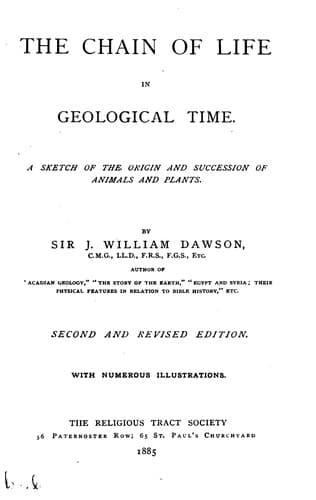
The Chain of Life in Geological Time: A Sketch of the Origin and Succession of Animals and PlantsDawson, John William, Sir
Science
The Chain of Life in Geological Time: A Sketch of the Origin and Succession of Animals and Plants
Dawson, John William, Sir
Paleobotany; Paleontology
A third illustration of the partial character of these hypotheses may be
taken from the use made of the theory deduced from modern physical
discoveries, that life must be merely a product of the continuous
operation of physical laws. The assumption, for it is nothing more, that
the phenomena of life are produced merely by some arrangement of
physical forces, even if it be admitted to be true, gives only a partial
explanation of the possible origin of life. It does not account for the
fact that life as a force or combination of forces is set in antagonism
to all other forces. It does not account for the marvellous connection
of life with organisation. It does not account for the determination and
arrangement of forces implied in life. A very simple illustration may
make this plain. If the problem to be solved were the origin of the
mariner’s compass, one might assert that it is wholly a physical
arrangement both as to matter and force. Another might assert that it
involves mind and intelligence in addition. In some sense both would be
right. The properties of magnetic force and of iron or steel are purely
physical, and it might even be within the bounds of possibility that
somewhere in the universe a mass of natural loadstone may have been so
balanced as to swing in harmony with the earth’s magnetism. Yet we
should surely be regarded as very credulous if we could be induced to
believe that the mariner’s compass has originated in that way. This
argument applies with a thousandfold greater force to the origin of
life, which involves even in its simplest forms so many more adjustments
of force and so much more complex machinery.
Public-domain text, read in full here on John Shaqi.
Reviews
Reviews
No reviews yet
Be the first to share your thoughts on this work.
Elsewhere in the archive
Join the Discussion
Join the discussion
Sign in to leave a comment or review.
Sign InorCreate an account