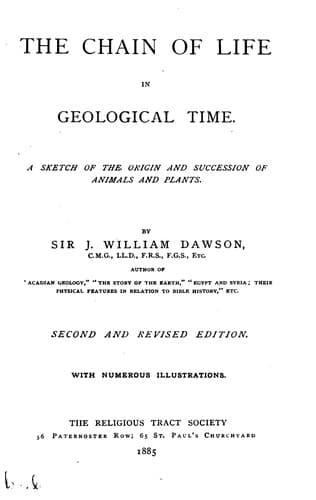
The Chain of Life in Geological Time: A Sketch of the Origin and Succession of Animals and PlantsDawson, John William, Sir
Science
The Chain of Life in Geological Time: A Sketch of the Origin and Succession of Animals and Plants
Dawson, John William, Sir
Paleobotany; Paleontology
Divine revelation carries us a step farther, and teaches us to recognise
in Jesus of Nazareth God manifest in the flesh, the Divine Logos
dwelling among men. But though this is a doctrine of revelation and not
of science, it is in perfect harmony with the plan of progress which we
have been sketching. It is the natural outcome of a process leading to
the introduction of a rational and accountable being, understanding
something of the works and ways of God, that to him God should reveal
Himself, and that the Divine Logos, by whom were “constituted the
ages”[94] of the world’s geological history, should preside also over
its future consummation, when all the degradation that has sprung from
the aberrations of fallen and imperfect humanity shall be removed, and
man himself shall become fully a partaker of the Divine nature.
The world we live in is thus not necessarily a finished world, and it is
now marred by the sins of man. What it may be in the future, we can
perhaps as little guess as an intelligence studying the Palæozoic world
could have understood that of the present time. But it is a glorious
truth to know that our Maker has revealed Himself to us also as a
Saviour, and that as individuals we shall not perish, to be replaced by
an improved species in the future, but that we ourselves, as sons of
God, may enter into and possess the new earth and new heavens of future
æons of the universe. Thus it would seem that the Gospel of Jesus Christ
is that which was wanting to complete and justify the history of nature
by bringing to light the final “restitution of all things,” and our own
union to God in a happy immortality.
FOOTNOTES:
[1] Croll has elaborated this calculation in his work, _Climate and
Time_.
[2] Sept. 1879.
[3] Analyses recently made by Mr. C. Hoffman, of the Geological Survey
of Canada, show that beds of graphitic gneiss, some of them 8 feet in
thickness, contain as much as 25·5 to 30 per cent. of carbon, the
remaining earthy matter consisting principally of silica, alumina, and
lime. The graphite from veins was nearly pure carbon, containing from
97·6 to 99·8 per cent. of that substance.
[4] Sometimes separated as a distinct order under the name of
_Radiolaria_.
[5] _Loftusia Columbiana_, Dawson, from British Columbia, is the only
Carboniferous species yet known.
[6] See Nicholson in the _Memoirs_ of the Palæontographical Society.
[7] _Archæospherinæ_ of the author.
[8] _Eophyton Linnæanum_ (Torrell).
[9] See Paper on “Footprints and Impressions of Animals,” _Am. Journal
of Science_, 1873.
[10] They probably belong to a large sponge named by Billings
_Trichospongia sericea_.
[11] _Amphispongia._
[12] _Geological Magazine_, May, 1878.
[13] It is regarded as somewhat doubtful whether these are Hydroids or
Bryozoa.
[14] _Heliopora_, an Alcyonarian; _Pocillopora_, an Anthozoan.
[15] _Haplophyllia_, _Guynia_, _Duncania_, of Pourtales.
[16] _Palæchinus._
Public-domain text, read in full here on John Shaqi.
Reviews
Reviews
No reviews yet
Be the first to share your thoughts on this work.
Elsewhere in the archive
Join the Discussion
Join the discussion
Sign in to leave a comment or review.
Sign InorCreate an account