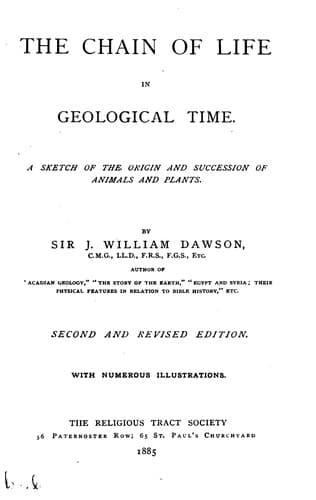
The Chain of Life in Geological Time: A Sketch of the Origin and Succession of Animals and PlantsDawson, John William, Sir
Science
The Chain of Life in Geological Time: A Sketch of the Origin and Succession of Animals and Plants
Dawson, John William, Sir
Paleobotany; Paleontology
minimum of 100 millions of years may represent the time since a solid
crust first began to form. As it is more likely that the rate of
denudation has on the average been greater in former geological periods
than at present, we may perhaps estimate fifty or sixty millions of
years as the time required for the accumulation of all our formations.
Some geologists object to this as too little, but in this some of them
are influenced by the exigencies of theories of evolution, and others
appear to have no adequate conception of the vast lapse of time
represented by such numbers, in its relation to the actual rates of
denudation and deposition.
It should be mentioned here, however, that, on certain theories now
somewhat generally accepted, respecting the nature and source of solar
heat, the absolute duration of geological time would be much reduced
below the estimate of Sir Wm. Thomson. Prof. Tait has based on such data
an estimate of fifteen millions of years. Prof. Simon Newcomb says that
“on the only hypothesis science will now allow us to make respecting the
source of the solar heat” (the gravitation hypothesis of Helmholtz) “the
earth was, twenty millions of years ago, enveloped in the fiery
atmosphere of the sun.” Dr. Kirkwood has called attention to these
results in connection with the planetary hypothesis of La Place, in the
_Proceedings of the American Philosophical Society_.[2] Should such
views prove to be well-founded, geological calculations as to the time
required for the successive formations may have to be revised.
If now we attempt to divide this time among the formations known to us,
according to their relative thicknesses, we have, according to an
elaborate estimate of Professor Dana, the time ratios of 12, 3, and 1
for the Palæozoic, Mesozoic, and Cainozoic periods respectively. Taking
the whole time since the beginning of the Cambrian as forty-eight
millions of years, we should thus have for the Palæozoic thirty-six
millions, for the Mesozoic nine, and for the Tertiary three. Another
calculation, recently made by Professors Hull and Haughton, gives the
following ratios:—
Azoic 34·3 per cent.
Palæozoic 42·5 ”
Mesozoic and Cainozoic 23·2 ”
This calculation is, however, based on the absolute thickness of the
several series as ascertained in Great Britain, without reference to the
nature of the beds, as indicating different rates of accumulation. Under
either estimate it will be seen that the Palæozoic time greatly exceeds
the Mesozoic and Cainozoic together, and consequently that changes of
life seem to have proceeded at an accelerated rate as time wore on.
Another inquiry of some importance relates to the manner of preservation
of fossils, and the extent to which they constitute the material of
rocks. This inquiry is doubly important, as it bears on the genuineness
of fossil remains, and on the means we have of understanding their
nature.
Public-domain text, read in full here on John Shaqi.
Reviews
Reviews
No reviews yet
Be the first to share your thoughts on this work.
Join the Discussion
Join the discussion
Sign in to leave a comment or review.
Sign InorCreate an account