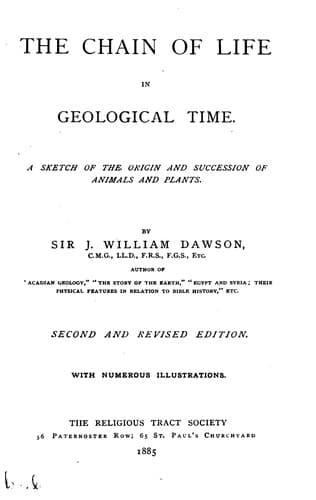
The Chain of Life in Geological Time: A Sketch of the Origin and Succession of Animals and Plants — John Shaqi
The Chain of Life in Geological Time: A Sketch of the Origin and Succession of Animals and PlantsDawson, John William, Sir
Science
The Chain of Life in Geological Time: A Sketch of the Origin and Succession of Animals and Plants
Dawson, John William, Sir
Paleobotany; Paleontology
The day must have been when the first living being appeared for the
first time on our planet. Was it plant or animal? or a generalised
organism uniting in some mysterious way the properties and powers of two
kingdoms of nature, now so distinct, and even contrary to each other in
their manifestations? Did it appear suddenly, or was it slowly evolved
from dead matter by some process in which the albuminous or protoplasmic
matter, which we know forms the basal substance of living beings, was
first produced and then endowed with life? Did the first living being
appear in a mature state, or was it merely a germ from which the mature
individual could be produced? These are questions which science in its
present state has no means of answering. We do not know any process by
which the ingredients of protoplasm can be combined so as to produce
that substance without a previous living being. We do not know what
molecular differences may exist between dead albumen and that which we
see growing and moving and instinct with life; still less do we know how
to set up or establish these differences. We do not know the precise
nature or relation to other forces of the energy which actuates living
organisms. In our experience the simplest creatures that have life
spring from previous germs, themselves the products of previous
generations of living beings. Thus we are in the presence of great
mysteries which it might be impossible for us to solve, even if we were
permitted to visit some new planet on which the dawn of life was
breaking.
Some things, however, we can infer as to the conditions of the
introduction of life.
First, there is every reason to believe that the earth we inhabit was
once a glowing, incandescent mass, condensing from a vaporous condition,
and quite unfit for the abode of living beings, and which, even if in
some previous state its materials had constituted the mass of an
inhabited world, must have lost every trace of any living germ in the
fervent heat to which it had been subjected. There must, therefore, have
been in some way an absolute creation or origination of life and
organisation.
Public-domain text, read in full here on John Shaqi.
Reviews
Reviews
No reviews yet
Be the first to share your thoughts on this work.
Join the Discussion
Join the discussion
Sign in to leave a comment or review.
Sign InorCreate an account