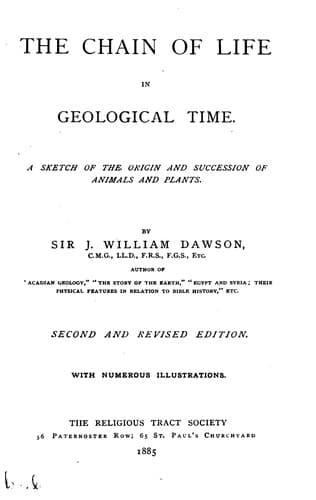
The Chain of Life in Geological Time: A Sketch of the Origin and Succession of Animals and PlantsDawson, John William, Sir
Science
The Chain of Life in Geological Time: A Sketch of the Origin and Succession of Animals and Plants
Dawson, John William, Sir
Paleobotany; Paleontology
It is likely that much of the present appearance and condition of the
most ancient rocks may be attributed to metamorphism, that is, to the
slow baking under the influence of heat, heated water, and pressure, to
which they have been subjected in the lower parts of the earth’s crust,
when buried deeply under newer deposits. It is also true, however, as
Dr. Sterry Hunt has pointed out in detail, that they present mineral
characters which show a mode of deposition different from that which has
prevailed subsequently, and probably indicating great ejections of
heated mineral matter into the primitive ocean, and comparatively little
of that deposit therein of mere sand and clay which has prevailed in
subsequent geological periods. In short, these rocks have an
unmistakably primitive aspect, distinguishing them from those of later
times, and conveying the impression that they approach at least to the
records of that time when a heated ocean first rested on the thin and
recently solidified crust of our planet. If this is really the case,
then our Lower Laurentian—hard, compact, destitute of limestone, and
composed of material which may be little else than the _débris_ of
products of internal heat merely spread out into bedded forms by
water—may represent a time when no living thing as yet tenanted the
waters; and the dawn of life may have appeared in that period when the
Middle Laurentian beds were laid down. Here at least we find two kinds
of evidence pointing to the existence of certain forms of life in the
waters.
The first depends on the mineral character of the beds themselves. This
formation holds several very thick beds of limestone. Now although this
kind of rock may, under certain circumstances, be deposited directly
from solution in water, it is not ordinarily so deposited, but more
usually through the agency of living beings inhabiting the waters, and
forming their skeletons or hard parts of limestone derived from the
water, usually through the medium of humble forms of plant life. In this
way are formed reefs of coral and beds of shells and of chalky ooze, all
composed of material once constituting the skeletons of animals. The
study of limestones of all geological ages shows that this has been the
usual mode of their formation. If the Laurentian limestones had a
similar origin, the seas of that period must have swarmed with animals
having calcareous coverings; and the study of more modern limestones
which have become highly crystalline shows that it is quite possible
that the forms and structures of these organisms may have been
obliterated.
Public-domain text, read in full here on John Shaqi.
Reviews
Reviews
No reviews yet
Be the first to share your thoughts on this work.
Join the Discussion
Join the discussion
Sign in to leave a comment or review.
Sign InorCreate an account