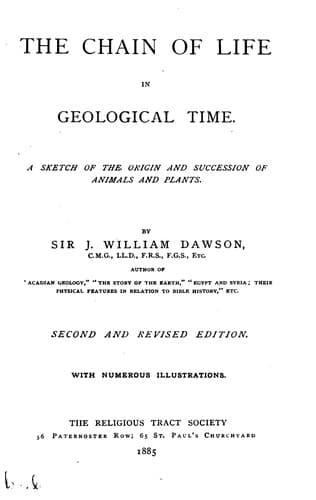
The Chain of Life in Geological Time: A Sketch of the Origin and Succession of Animals and PlantsDawson, John William, Sir
Science
The Chain of Life in Geological Time: A Sketch of the Origin and Succession of Animals and Plants
Dawson, John William, Sir
Paleobotany; Paleontology
In the few years that have elapsed since the publication of the first
edition of this work, great additions have been made to our knowledge of
fossil animals and plants. Many new species have been described, and
many new facts have been discovered, respecting species previously
known. This rapid progress of discovery has, however, invalidated few of
the statements made in the first edition, and has certainly established
nothing against the general laws of the succession of life as stated in
this work.
Perhaps the most interesting phase of recent discovery is the tracing
back of certain forms of life to earlier periods of the earth’s
geological history. Some of the most recent facts of this kind are the
finding, by M. Charles Brongniart, of a fossil insect, allied to the
_Blattae_ or cockroaches, in the Silurian of Spain, that of true
Scorpions in the Upper Silurian of Sweden by Lindström, and in the Upper
Silurian of Scotland by Peach, who has also described fossil Millipedes
from the Lower Devonian. The tendency of such discoveries is to carry
farther back the origin of highly specialised forms of life, and thus to
render less probable their origin by any process of gradual derivation.
Other discoveries serve to fill up blanks in our knowledge, and thus to
render the geological record less imperfect. Of this kind is the close
approximation now worked out in Western America between the end of the
reign of the great Mesozoïc reptiles and the beginning of that of the
mammals of the Tertiary—a great and abrupt revolution, effected
apparently by a _coup de main_. I have myself had opportunity to show
that a similarly sharp line separates that quaint old Mesozoïc flora of
pines, cycads and ferns, which extends upward into the Lower Cretaceous,
from the rich and luxuriant assemblage of broad-leaved trees of modern
aspect, which takes its place in the middle part of the same formation.
It is not too much to say that these and similar discoveries, while they
serve to bridge over gaps in the succession of organic beings, do not
favour the theory of slow modification of types. They rather point to a
law of rapid development of new forms under special conditions as yet
unknown to science, and this accompanied with the extinction of older
species. Recent discoveries also present many remarkable instances of
the early introduction of highly specialised types, of higher forms
preceding those that are lower in the same class, and of the persistence
of certain types throughout geological time without any important
change.
J. W. D.
MCGILL COLLEGE.
CONTENTS.
CHAP. PAGE
I. PRELIMINARY CONSIDERATIONS AS TO THE EXTENT AND
SOURCES OF OUR KNOWLEDGE 1
II. THE BEGINNING OF LIFE ON THE EARTH 21
III. THE AGE OF INVERTEBRATES OF THE SEA 45
Public-domain text, read in full here on John Shaqi.
Reviews
Reviews
No reviews yet
Be the first to share your thoughts on this work.
Join the Discussion
Join the discussion
Sign in to leave a comment or review.
Sign InorCreate an account