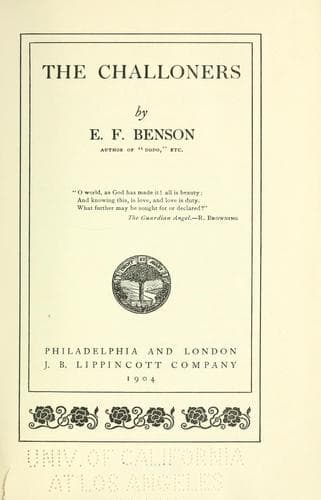
Clergy -- England -- Fiction; England -- Social life and customs -- Fiction; Families -- England -- Fiction
The poor professor suffered for his momentary panic, for Helen had, in
his hour of weakness in the drawing-room, changed her place to behind a
large flower-tub, which had concealed nobody before. Consequently, he
approached it inattentively, without caution or misgiving, to be
confronted, shuddering, by a flapping form which gasped and panted.
He made a fruitless appeal.
“Dear Miss Helen,” he said, “I can’t go on. I really do not think it
would be right. My work will suffer. But is it Dr. Arne among the
gooseberry bushes or is it Martin? I think I could run as fast as Dr.
Arne, but if----“
Hoots of unearthly laughter assailed him on the other side.
* * * * *
Afterwards they played “Dumb Crambo.” Lady Susan, in a college cap and a
dust-coat of Martin’s, was Alfred letting the cakes burn. At another
time Dr. Arne found himself to be Cleopatra, with Helen as Mark Antony.
He chose his dresses from Helen’s wardrobe--they were much too large
for him--with immense care, and subsequently applied a paper-weight, in
the form of a snake, to his bosom. The professor of poetry became a
prize-fighter, his wife, a godly and virtuous woman hitherto,
unexpectedly turned out to be Peace the murderer, and did a deed of
blood with immense gusto and a paper-knife. Yet, all the time, nobody
asked himself why he did these silly things; the twins had said it was
to be so, and that was enough. At their order, too, it seemed as if the
golden gates of youth had swung open, and the tired and the patient and
the elderly and the wise were bidden to enter once more and be children
again.
* * * * *
Public-domain text, read in full here on John Shaqi.
Reviews
Reviews
No reviews yet
Be the first to share your thoughts on this work.
Elsewhere in the archive
Join the Discussion
Join the discussion
Sign in to leave a comment or review.
Sign InorCreate an account