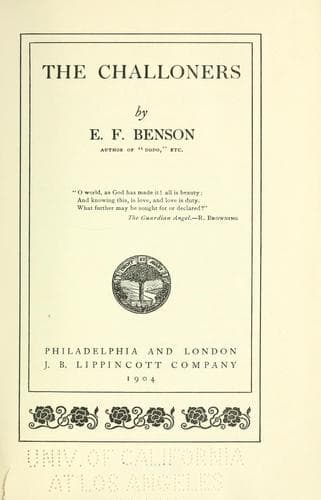
Clergy -- England -- Fiction; England -- Social life and customs -- Fiction; Families -- England -- Fiction
But all this, the charm of which Karl Rusoff felt almost too keenly for
his peace of mind, he knew to be extremely dangerous, and to him this
exultant, beautiful mind was entrusted with all the responsibility that
it entailed, to fashion, to train, to prune. With a true and honest
modesty he recognised how menial, so to speak, his work in regard to
Martin was; but this did not lessen the responsibility. He was, to rate
himself at the highest, the gardener who had to bring this exquisite
plant into fulness of flower, to feed, to water, to cut, and, above all,
to let air and sun, the great natural influences, have their way with
it. He did not believe in forced growth or in sheltered cultivation; as
he had told Martin in the summer, every emotion, every pain and joy, so
long as it was not sensual, was his proper food. The richer his
experience was, the richer would his music be. Karl had already seen a
first clear endorsement of his view in the circumstances attending
Martin’s secession to the Roman Church. He himself did not know with any
exactitude of detail what had passed between him and his father, but
though the painfulness of that had knocked Martin completely up for a
time, what he himself had foreseen had come true, and he could hardly
help inwardly rejoicing at even the cruelty of Mr. Challoner’s attitude
to his son, so great had been the gain to Martin artistically. He had
suffered horribly, and was the better for it. Afterwards--the thing had
taken place now more than two months ago--the elastic fibre of his youth
had reasserted itself, and his exuberant health of body and mind had
returned to their former vigour. The pain had passed, the gain remained.
* * * * *
Then to Karl’s reverie there came the interruption he had been
expecting. A quick step sounded outside, then a noise as of a large
quantity of books being dropped in the passage, a loud and hollow groan,
and, after a short pause, Martin, with half a dozen volumes of music,
entered, flushed, vivid in face, muddy in boots.
“I am late,” he said, “also I am sorry. But there was not a cab to be
found. So I ran. I ran quicker than cabs. Oh, how hot I am!”
Karl’s face lighted up as he saw him. He himself was unmarried and
rather lonely in the world till this child of his old age had come to
him, who should be, so he told himself, the crown of his life’s work,
and illuminate the dull world, long after he himself was dead, with the
melodious torch that he had helped to light.
“Are you late?” he said. “I have only just finished practising myself.
My dear child, how hot you are. Let us have tea first. And are you
dining out to-night? If not, have a chop with me here, and we can work a
little afterwards as well. You have not been to me for a week.”
“Yes, thanks, I should like that,” said Martin. “I have been down at
Chartries, as you know, for a couple of days.”
He paused a moment, frowning at the fire.
Public-domain text, read in full here on John Shaqi.
Reviews
Reviews
No reviews yet
Be the first to share your thoughts on this work.
Elsewhere in the archive
Join the Discussion
Join the discussion
Sign in to leave a comment or review.
Sign InorCreate an account