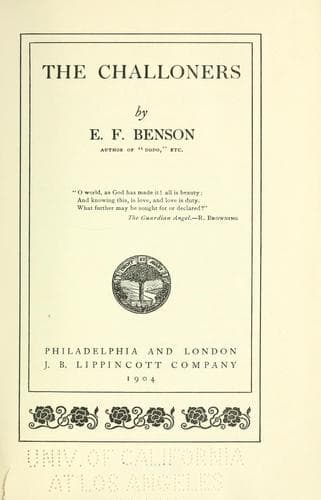
Clergy -- England -- Fiction; England -- Social life and customs -- Fiction; Families -- England -- Fiction
He played a few bars of very intricate phrase after the manner of the
opening of a fugue. Then in the bass half the phrase was repeated, but
it finished with something perfectly different, a third and a fourth or
a fifth joined in, and before the “whole kennel was a-yelp” the original
subject had passed through rapid gradations until it had become
something totally different to what it began with, though still an
incessant jabber of cognate phrases, never quite coherent, were somehow
strung together and worked against each other by a miracle of ingenuity.
Then the original subject was repeated with emphatic insistence, as if
to call renewed attention to itself, but it was answered this time by a
phrase that had nothing whatever to do with it; a third short melody
totally different from anything that had gone before or was to come
after ran its brief and ridiculous course, and then a perfect
hodge-podge of reminiscences of all that had previously occurred,
handled with extraordinary dexterity, made the brain positively reel and
swim. Finally a huge bravura passage, as much decked out with ribands
and lace as a fashionable woman at a party, brought this insane
composition, which taxed even Martin’s fingers, to a totally unexpected
close.
Karl Rusoff had listened at first with sheer uncomprehending
bewilderment, unable, since indeed there was neither head nor tail nor
body to it, to make anything whatever out of it, and for a moment he
wondered if Martin was merely playing the fool. But as he looked at his
face bent over the piano, and saw even his fingers nearly in
difficulties, a sudden light struck him, and he began to smile. And
before the end was reached he sat shaking in his chair with hopeless
laughter.
“Ah, you wicked boy,” he said, “why even our dear Lady Sunningdale would
recognise herself.”
Martin pushed his plume out of his left eye and laughed.
“That’s the joy of it,” he said. “She did recognise it. About half way
through she said, ‘Why, that’s me.’ You know you told me to do that,--to
take anything, the east wind, or a London fog, or a friend, and make
music of it.”
“Play it once more, if you will,” said Karl, “and then to work. Not that
that is no work. There is a great deal of work in that. Also I perceive
with secret satisfaction that you do not find it easy to play. But the
bravura is rather unkind. She is never quite like that.”
“Ah, the bravura is only her clothes,” said Martin, preparing to begin
again. “She even told me which hat she had on. It is the one she
describes as a covey of birds of paradise which have been out all night
in a thunderstorm, sitting on a tomato-salad.”
Public-domain text, read in full here on John Shaqi.
Reviews
Reviews
No reviews yet
Be the first to share your thoughts on this work.
Elsewhere in the archive
Join the Discussion
Join the discussion
Sign in to leave a comment or review.
Sign InorCreate an account