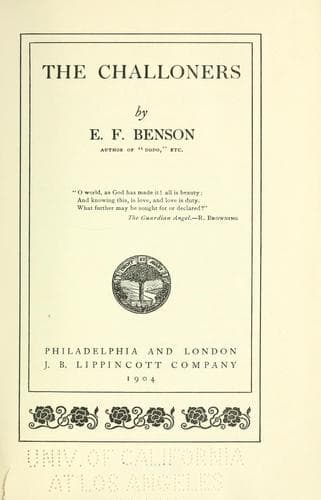
Clergy -- England -- Fiction; England -- Social life and customs -- Fiction; Families -- England -- Fiction
Stella Plympton about this time was giving a certain amount of anxiety
to her parents. The amount, it is true, was not very great, because her
father was a happily constituted man who was really incapable of feeling
great anxiety except about large sums of money. Consequently, since the
extremely large sums of money, all of which he had made, were most
admirably invested, his life was fairly free from care. His wife also
was quite as fortunate, her complexion was the only thing capable of
moving her really deeply, and as she had lately found a new _masseuse_
who was quite wonderful and obliterated lines with the same soft
completeness with which bread-crumb removes the marks of lead-pencil,
she also, for the present, stood outside the zone of serious trouble.
Between them they occupied, just now, the apex of social as well as most
other successes in London, and were a very typically modern couple. Sir
Reginald Plympton had in early life invented an oil-cloth of so eminent
an excellence that in its manufacture and exploitation he had been too
busy to really master the English aspirate, which still bothered him.
But to make up for this he had carefully cultivated his aspirations,
and had (entirely owing to oil-cloth), while not yet sixty, amassed a
colossal fortune, married the daughter of an impecunious duke, won the
Derby, and now stood perched on the topmost rung of the ladder of
English society. He had a yacht, which never went for long cruises, but
always anchored for the night in some harbour. Being a bad sailor, he
left it, if there was a chance of bad weather, before it weighed anchor
in the morning, and joined it again on the ensuing evening. Similarly he
sat in his wife’s opera-box during intervals between the acts, and left
his place on the rising of the curtain. He was already a baronet and an
M.P., and his peer’s coronet, so to speak, was now being lined.
Yet care, though only like a little draught, just stirred the warm air
of Lady Monica’s drawing-room and made the palm-trees rattle. She had
often talked the matter over with her husband, who had no very practical
suggestion to make. He would stand before her, very square and squat,
with his hands in his pockets, rattling money in the one and keys in the
other, and say:
“Well, my lady, you give ’er a good talkin’ to. Tell ’er to be a good
girl, and be sensible. And now I must be off.”
Public-domain text, read in full here on John Shaqi.
Reviews
Reviews
No reviews yet
Be the first to share your thoughts on this work.
Elsewhere in the archive
Join the Discussion
Join the discussion
Sign in to leave a comment or review.
Sign InorCreate an account