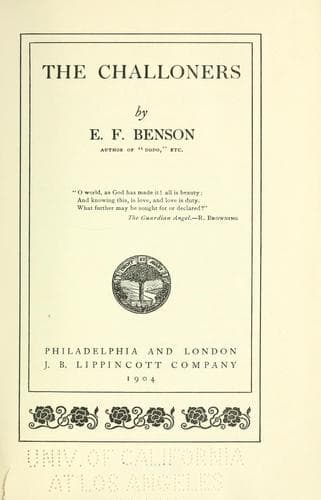
Clergy -- England -- Fiction; England -- Social life and customs -- Fiction; Families -- England -- Fiction
For the fact was that Stella was now nearly twenty-three. She had
refused several very suitable offers, and her mother, extremely anxious,
as all good mothers should be, to get her married, had lately begun to
be afraid that she was “being silly.” This in her vocabulary meant that
Stella was in love with somebody (Lady Monica thought she knew with
whom) and was not clever enough to make him propose to her. What added
enormity to her “silliness” was the fact that he was extremely eligible.
Lady Monica had no sympathy with this sort of thing; she had never been
silly herself, and her own sentimental history had been that some
twenty-four years ago she had wooed, proposed to, and wedded her
Reginald without any fuss whatever or any delay. She was a woman with a
great deal of hard, useful common sense; she always knew exactly what
she wanted, and almost always got it. Her only weakness, in fact (with
the discovery of the new _masseuse_, her complexion had become a
positive source of strength), was for feeble flirtations with young men
of the age which she herself wished to look. These never came to
anything at all; and when the young man in question married somebody
perfectly different, she told all her friends that she had made him. She
had during the last week or two, since the session had brought them to
London, done a little vicarious love-making to Martin on Stella’s
account, and enjoyed it on her own. She was a perfectly honest woman,
and only played with fire as a child plays with matches, lighting them
and blowing them out, and she never really set fire to herself, and
quite certainly never even scorched anybody else.
But anxiety, like a draught, had reached her with regard to Stella’s
future, and the next evening, when Lady Sunningdale happened to be
giving a menagerie-party, she determined to have a few words with her,
for she was looked upon as a sort of book of reference with regard to
the twins. The menagerie-party was so called because for a week
beforehand Lady Sunningdale drove about London a good deal and screamed
an invitation to everybody she saw in the streets. The lions only were
fed; the meaner animals and those lions only observed too late to ask to
dinner came in afterwards.
Lady Monica and Stella belonged to this second category, and Lady
Sunningdale hailed them with effusion.
Public-domain text, read in full here on John Shaqi.
Reviews
Reviews
No reviews yet
Be the first to share your thoughts on this work.
Elsewhere in the archive
Join the Discussion
Join the discussion
Sign in to leave a comment or review.
Sign InorCreate an account