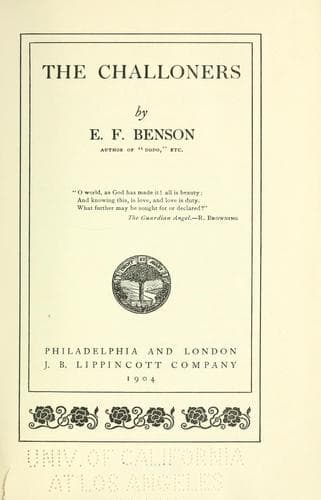
Clergy -- England -- Fiction; England -- Social life and customs -- Fiction; Families -- England -- Fiction
And bread, bread of the soul, had come to her; her table had been laid
in the wilderness, and happiness, royal inward happiness of a very fine
and unselfish sort, in the midst of a thousand things which made for
unhappiness, had blossomed in her. A thousand times she had been tempted
to say, “It is doing no good. Why should I put off what is waiting for
me when my renunciation does not help father in any way?” But a thousand
times she had just not said it; and now, at the end of these difficult
months, she could without egoism look back and see what infinite good
had been done. That her father should in any way alter his own
convictions about her marriage she had never expected; but what had been
gained was that he saw now, and consciously saw, that she was in the
very simplest language “being good.”
But it had been difficult enough for all concerned, except perhaps for
Aunt Clara, who was scarcely capable of emotion, and often Helen’s heart
had bled for her father. It had been most terrible of all when Martin
had joined the Roman Church. His letter to his father--Helen winced when
she thought of it now--had arrived on Sunday morning, and he had found
it on the breakfast-table when he had come back from the early
celebration. It was a manly, straightforward letter enough, stating that
he had not yet gone over, but had practically determined to. If his
father wished he would come down to Chartries, and talk it over with
him, and give to his advice and counsel the very fullest possible
consideration. And at the end he expressed very bluntly and sincerely,
as was his way, the sorrow and the pain that he knew the news would
cause his father.
The sheet fell from his hand, and Helen, who was making tea, looked up.
She saw the colour rise in her father’s face; the arteries in his neck
and temples swelled into cords, and his eyes with pupils contracted to
pin-pricks looked for the moment like the eyes of a madman. Then he
spoke, his voice vibrating with suppressed furious anger.
“Martin is going to join the Roman Church,” he said. “From the day he
does so, Helen, never speak to me of him again. He is dead to me,
remember.”
That was a week before Christmas, and for more than a month after that
Martin’s name had literally hardly crossed his father’s lips. The boy
had come down to stay with his uncle once, but Mr. Challoner had
absolutely refused to see him. He had even wished Helen not to; but on
this occasion, for the only time during all that long winter, she had
quietly but quite firmly disobeyed him. It was then first, too, as one
looking down from barren rocks of a mountain-range, that she saw, though
still far off, the harvest that was ripening in these long, patient
months of her living here with her father. Before going to Chartries she
had thought best to go into his study and tell him that she was doing
so.
Public-domain text, read in full here on John Shaqi.
Reviews
Reviews
No reviews yet
Be the first to share your thoughts on this work.
Elsewhere in the archive
Join the Discussion
Join the discussion
Sign in to leave a comment or review.
Sign InorCreate an account