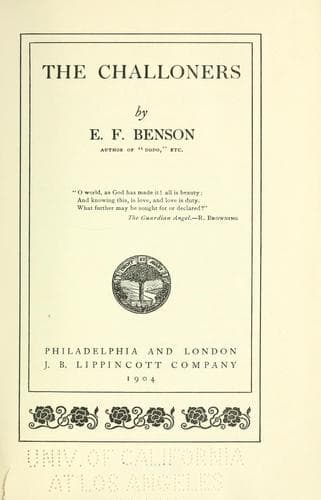
Clergy -- England -- Fiction; England -- Social life and customs -- Fiction; Families -- England -- Fiction
Martin felt his mouth go suddenly dry as he spoke, but he was past
really caring what might happen. His father, he knew, was about as angry
with him as he could be, and he himself hated and feared his anger in
the instinctive unreasoning way in which a grown man will fear something
which can really hurt him no longer, but which he feared in childhood.
That vibrating note was in his father’s voice which he associated with
early failures of his own in Latin declensions, and the hint of what
would have happened to him if he had been younger also carried him back
to early, dreadful scenes. But finding his father did not reply, he
looked up at him, and saw that the anger in his face had been
extinguished like a wind-blown lamp. But all tenderness, all sense of
being intimate with him was so alien to Martin that he did not trouble
to guess what emotion had taken the place of anger. Anger, however, was
gone, taking his own fear with it, and with a certain mercilessness
characteristic of youth, he deliberately, so to speak, hit back.
“Whatever I do, you find fault with,” he said. “I try to please you, it
is no use. Would it not be better if I went away? There is no good in my
stopping here; I don’t suppose this sort of thing gives you any
pleasure. Uncle Rupert, I am sure, would let me go and stay with him in
London next week till the Long Term begins at Cambridge. That will be in
another fortnight. You told me you wished me to be up there all the
time. So would it not be much better if I went away?”
His father did not reply at once, but sat fingering his writing things
with rather tremulous hands.
“Are you not happy at home?” he asked at length.
“No,” said Martin, shortly.
The brevity and certainty of this struck more deeply yet. If Martin a
few months before had felt sick at his father’s anger, the latter was
certainly the more to be pitied now.
“Martin, what is the matter between us?” he said.
“I don’t know; but it’s the same as it has always been, only it’s rather
worse. I can’t please you, I suppose, and you are always down on me for
something. It is to be hoped it is doing some good, because otherwise it
seems,--well, rather unnecessarily unpleasant. First it was my work,
then what I said to Helen, then ‘The Mill on the Floss,’ and now this.
To-morrow it will be something else. There is sure to be something. I
daresay I don’t understand you, and I know you don’t understand me.
This afternoon, for instance. Oh, it’s no use trying to explain,” he
said.
“It may be the utmost use. It may make the greatest difference. I only
wish that you had said to me years ago what you are saying now. I have
tried to be a good father to you, but sometimes, often, I have been
puzzled as to what to do. You don’t confide in me, you don’t tell me
your joys and pleasures, and let me share them. I often hear you
laughing when I am not with you. But when I am, not so often.”
Martin half shrugged his shoulders, as if to say, “There we are again.”
Public-domain text, read in full here on John Shaqi.
Reviews
Reviews
No reviews yet
Be the first to share your thoughts on this work.
Join the Discussion
Join the discussion
Sign in to leave a comment or review.
Sign InorCreate an account