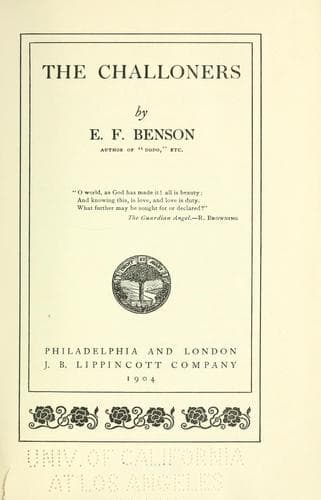
Clergy -- England -- Fiction; England -- Social life and customs -- Fiction; Families -- England -- Fiction
He had, in fact, many pleasant qualities and one notable one, which Lady
Sunningdale had already mentioned as being characteristic of him,
namely, his undeviating pursuit of the first-rate. It was this which
turned a character that would otherwise have been rather materialistic
into something of an idealist, and supplied a sort of religion to a mind
which otherwise, an extremely rare phenomenon, was completely atheistic,
not with an atheism into which he had drifted from carelessness or
_insouciance_, but with one that sprang from a reasoned and clear
conviction that there could not possibly be any God whatever. On all
other matters he had an open mind and was extremely willing to adopt any
opinion that seemed to him reasonable, but on this one point he was
hopelessly bigoted. This reasonableness and willingness to be convinced
had led people to suppose that he was weak. But this was not in the
least true, he was only fair. Another quality, and a fine one, was his
also: he was practically unacquainted with fear, either physical or
moral, and would, had he lived in those uncongenial times, have gone as
cheerfully to the stake for his entire absence of religious beliefs as
he would now blandly uphold his abhorrence of sport on the ground of
cruelty to animals in a roomful of hunting-men. His faculty of reverence
finally, of which he possessed a considerable measure, he exercised
entirely over the talents of other people, on whatever line they ran. He
knelt, for instance, at the shrine of Lady Sunningdale’s acute
perceptions, he hung up votive offerings to Martin’s music, he even, at
this moment, bowed the knee before the village carpenter, whose talent
for singing the wrong note was of that instinctive and unerring quality
which approaches genius.
He was a great friend of Martin’s. Helen he only knew slightly. And,
after service, desultory conversation in the church-yard ended in the
twins going back to lunch at Chartries. Though Mr. Challoner was opposed
on principle to anything, however remote, connected with festivity
taking place on Sunday, he raised no objection, merely reminded Helen
that her Sunday-school class met at three. Lord Yorkshire, strolling by
her, thought he heard a _nuance_ of impatience in her assent, and his
question had a touch of insincerity about it.
“Don’t you find that charming?” he asked. “I think there can be nothing
so interesting as helping to form a child’s mind. It is so plastic--like
modelling clay. You can mould it into any shape you choose!”
Helen glanced quickly at him.
“Do you really want to know if I find it charming?” she asked.
“Immensely.”
“I detest it. I don’t think they have any minds to mould. Why should one
think they have? But they have shiny faces, and they fidget. And I point
out Ur of the Chaldees on the map.”
He laughed.
Public-domain text, read in full here on John Shaqi.
Reviews
Reviews
No reviews yet
Be the first to share your thoughts on this work.
Elsewhere in the archive
Join the Discussion
Join the discussion
Sign in to leave a comment or review.
Sign InorCreate an account