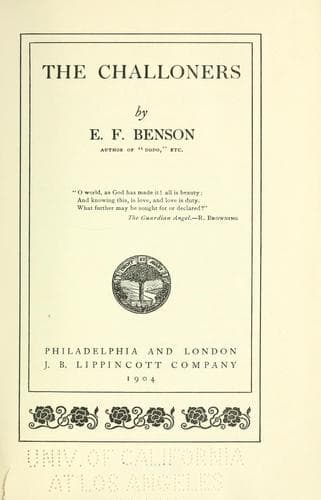
Clergy -- England -- Fiction; England -- Social life and customs -- Fiction; Families -- England -- Fiction
“I suppose the chances are in favour of their not having minds, as you
say,” he remarked. “But I had to allow for your delighting in it, when I
started the subject. What do they think about then? Do they just chew
their way through life like cows? You know some people don’t chew
enough. I expect Martin doesn’t. But that is why he is so
extraordinary.” There was intention in this, and it succeeded. Any one
who admired Martin had found a short cut to his sister’s favour.
“Ah, Martin never chews,” she said. “I don’t think he ever thinks; he
just--just blazes. Now, do tell me, Lord Yorkshire, because you know him
well. He isn’t stupid, is he, because he can’t or doesn’t pass
examinations?”
“He couldn’t conceivably be stupid, any more than I could be a Red
Indian. But it is by a misguided ingenuity that he contrives not to
pass examinations. It is hardly worth while doing it.”
“Ah, do tell him that,” said Helen. “I think you have influence with
him.”
“What on earth makes you think that?”
“He quotes you.”
“Are you sure you do not mean he mimics me? He does it to my face, too,
so why not behind my back. It is quite admirable. Ah, I see he has shown
you a specimen. Don’t I talk wonderfully like him? But influence,--one
might as well sit down and think how to influence a flash of lightning.”
Helen considered this a moment.
“Well, there are such things as lightning-conductors,” she said.
“Besides, there are times when Martin isn’t the least like a flash of
lightning. He is often like a stagnant pool.”
“I don’t recognise that,” said Frank.
“No, you probably have never seen it.”
They had passed out of the narrow path from the church-yard during this,
and their way lying across the open fields, Lady Sunningdale, as her
habit was, annexed Frank as well as Martin.
“Dear Helen, it is too bad,” she said as she manœuvred. “You will have
to go back immediately after lunch. What is a Sunday-school? It sounds
so beautiful, like a hymn tune. Yes, I adore church-music; really there
is nothing like it. And it was so wonderful of you to play the
lucubrations of Mendelssohn, Martin.”
“Yes, I felt that, too,” said Frank, in his low, slow voice. “There was
a stained-glass window just opposite me which was exactly like the
tone-colour of Mendelssohn. A figure which I take to have been a
prophet, probably minor, in jewelled slippers was directing an enamoured
gaze towards a pink town,--which may or may not have been the New
Jerusalem. I always wonder where artists in stained-glass get their
botany from. Nameless herbs enveloped the feet of the minor prophet.”
Martin laughed.
“I know that window,” he said. “When I was little it used to come into
my nightmares. Now it has become a daymare. I don’t know which is
worst.”
Lady Sunningdale sighed.
Public-domain text, read in full here on John Shaqi.
Reviews
Reviews
No reviews yet
Be the first to share your thoughts on this work.
Elsewhere in the archive
Join the Discussion
Join the discussion
Sign in to leave a comment or review.
Sign InorCreate an account