Clergy -- England -- Fiction; England -- Social life and customs -- Fiction; Families -- England -- Fiction
“Has he been at you again?”
“Yes, I think you might call it that without conveying a false
impression. He apparently wants to give me to understand that it is some
moral crime not to be able to do Greek iambics. Well, I am a criminal
then. I can’t. Also that it is impossible to be educated without. Then I
began arguing,--which is always stupid,--and said I supposed it depended
on what one meant by education. And he said he imagined he was the best
judge of that. So there we were.”
“And what do you mean by education?” asked Helen.
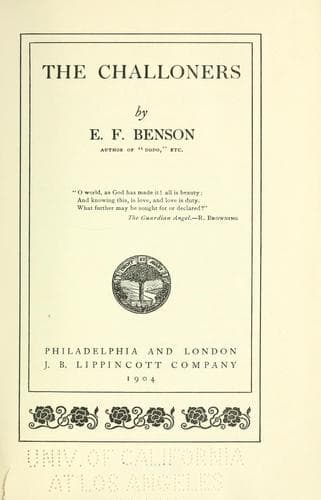
“Why, of course, the appreciation of beauty,” said Martin, quickly. “‘O
world as God has made it,’--you know the lines.”
“Ah, say them,” she said.
Martin sat up, tilting back his hat.
“‘O world as God has made it, all is beauty,
And knowing this is love, and love is duty,
What further may be sought for or declared?’”
“Yes, that isn’t a bad creed,” said Helen.
“I hope not, for it is mine. And it seems to me that you may look for
beauty and find it in almost everything. Where you look for it should
depend entirely on your tastes. Father finds it in the works of
Demosthenes, but I in the works of Schumann and a few other people he
has never heard of.”
“But aren’t Greek plays beautiful?” asked Helen.
“Oh, I daresay. But, being what I am, music concerns me more. Don’t
let’s argue. It is so enfeebling. When I begin arguing I always feel
like Mr. Tulliver, when he said, ‘It’s puzzling work, is talking.’”
Helen laughed.
“Well, you and I ought to be pretty well puzzled by now,” she said. “I’m
sure we’ve talked enough. I’ll play you one-half game of croquet before
dinner. Oh, by the way, father is dining with Uncle Rupert. You and Aunt
Clara and I will be alone. You will have to read prayers.”
“And sing the hymn an octave below,” remarked Martin.
The Honorable and Reverend Sidney Challoner--or, as he preferred to be
addressed, the Reverend-Honorable--was a man of method and economy who
hated wasting anything from time down to the brown paper in which
parcels arrived, and at this moment he was employing the half-hour
before it was necessary to go to dress for dinner at Chartries, his
brother’s place, which stood pleasantly among woods about a mile
distant, in finishing his sermon for Trinity Sunday. His study, where he
worked, was singularly like himself, and seemed as integral a part of
him as the snail-shell is of the snail. There was nothing, for instance,
in the least drowsy or dusty about the room. Everything was in its
place, the place of each thing being in every case strictly determined
by the use to which it was to be put, and the frequency with which it
was to be used. A scrupulously orderly and energetic severity in fact,
was the keynote of the room.
Public-domain text, read in full here on John Shaqi.
Reviews
Reviews
No reviews yet
Be the first to share your thoughts on this work.
Join the Discussion
Join the discussion
Sign in to leave a comment or review.
Sign InorCreate an account