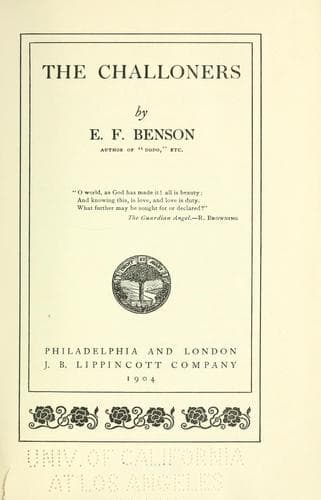
Clergy -- England -- Fiction; England -- Social life and customs -- Fiction; Families -- England -- Fiction
The temptation to say no more was extraordinarily strong, and to end
this beautiful day quite happily with every one--Aunt Clara had kissed
her twice, which she usually only did on Christmas morning--was the
childish impulse dominant in her. To-morrow she would deal with other
things, one perfect pearl of a day would be hers,--an imperishable
treasure. But the necessity of honesty, consecrated, as it were, by what
had passed between her and Frank on the subject, conquered. For the last
year she had occasionally smoked, and had never in the least desired to
tell her father that she did. Yet now, somehow, perhaps because it was
connected with him, she must. So she spoke.
“No, it is not quite finished,” she said. “I had been smoking, too.”
For a moment he almost failed to grasp this simple statement, then a
school-master voice rapped out a question.
“You smoke?” he asked.
“Not often; not much,” she said, with the old childish awe of him
suddenly returning.
“And who---- Did Martin teach you?” he asked, with an ironic emphasis on
“teach,” at that fine word being put to such base uses.
“No; I asked him for a cigarette,” she said.
“And he gave it you?”
There was no reply necessary. He had dropped her hand, as if it had been
a cigarette-end, but now he took it again.
“My dearest girl,” he said, “I do not want you for a moment to think
that I make much out of a little; do not think that I regard it as
morally wrong in any way. But think, Helen,--a girl like you smoking. Is
it seemly? Is it not a horrid, a nasty habit? And in the Room, too!
There, there, don’t tremble, my dear. I am not angry.”
There was a moment’s pause.
“Let us dismiss it altogether, Helen,” he said. “You told me, anyhow,
and I know it was hard for you to do that. But”--and he was father,
responsible father, when he should have been friend--“but you knew my
feeling about it. It was disobedient.”
All the time his heart was warmed by the thought that she had told him,
yet his sense of duty, his responsibility towards his children, which
was one of the most constant motives of his acts, made him say more. He
did not want to preach, but he was incapable of not doing so.
“Yes, disobedient,” he said, “to what you knew I felt. And that Martin
should give you a cigarette is as bad.”
“Ah, do not bring him into it,” she said. “I am stronger than
Martin,--he had to give it me. Martin would always do what I asked him.
Please do not write to him or speak to him about it.”
Then, at the thought of Martin, and of the constant, continual
misunderstandings between him and her father, her own great happiness
urged her to try to help him.
“I am much worse than Martin is, dear father,” she said; “much more
disobedient, much,--‘The Mill on the Floss,’ for instance. I had been
reading it.”
“And he had lent it you?” asked Mr. Challoner, quietly.
“No. I found it in his bedroom and took it. Oh, father----“
Public-domain text, read in full here on John Shaqi.
Reviews
Reviews
No reviews yet
Be the first to share your thoughts on this work.
Elsewhere in the archive
Join the Discussion
Join the discussion
Sign in to leave a comment or review.
Sign InorCreate an account