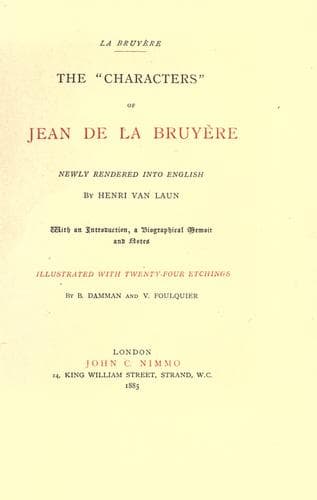
The "Characters" of Jean de La BruyèreLa Bruyère, Jean de
General
The "Characters" of Jean de La Bruyère
La Bruyère, Jean de
Character sketches -- Early works to 1800; Characters and characteristics
(15.) Theophilusʼ disease seems to be incurable; he has suffered
from it these thirty years, and now he is past recovery. He was, is,
and will always be desirous of governing the great; death alone can
extinguish with his life this craving for swaying and ruling other
minds. Is it in him zeal for his neighbourʼs weal, or is he accustomed
to it, or is it an excessive good opinion he has of himself? He
insinuates himself into every palace, and does not stop in the middle
of an apartment, but goes on to a window-niche or a closet; other
people wait to be seen or to have an audience till he has finished
his speech, which lasts generally a goodly time, during which he
gesticulates much. He penetrates the secrets of many families, has
a share in their good or bad fortunes; forestalls many an occasion,
offers his services, and forces himself upon people so discreetly[452]
that he must be admitted. The care of ten thousand souls, for which he
is accountable to Providence as much as for his own, is not sufficient
to employ his time or satisfy his ambition; there are others of a
higher rank, and of more consideration, for whom he is not responsible,
but of whom he officiously takes charge. He listens and watches for
anything that may gratify his spirit of intrigue, meddling and
muddling. A great man has scarcely set foot on shore, but he gets hold
of him, and pounces upon him; and we hear that Theophilus is his guide
and director before we could even suspect he had so much as thought of
it.[453]
(16.) A coldness or incivility from our superiors in rank makes us hate
them; but a bow or a smile soon reconciles us.
(17.) There are some proud men whom the success of their rivals humbles
and mortifies; it is a disgrace which even sometimes makes them return
your bow; but time, which alleviates all things, restores them at last
to their natural disposition.
(18.) The contempt the great feel for the common people renders them so
indifferent to their flattery or praises, that it does not feed their
vanity. In like manner, princes praised continually and unreservedly by
the great and the courtiers, would be more elated if they had a better
opinion of those who praise them.
(19.) The great believe themselves the only persons who are the pink
of perfection, and will hardly allow any sound judgment, ability,
or refined feelings in any of a meaner rank; but they arrogate to
themselves those qualities by virtue of their birth. However, they are
greatly in error in entertaining such absurd prejudices, for the best
thoughts, the best discourses, the best writings, and perhaps the most
refined behaviour, have not always been found among them. They have
large estates and a long train of ancestors, and there is no arguing
about those facts.[454]
Public-domain text, read in full here on John Shaqi.
Reviews
Reviews
No reviews yet
Be the first to share your thoughts on this work.
Elsewhere in the archive
Join the Discussion
Join the discussion
Sign in to leave a comment or review.
Sign InorCreate an account