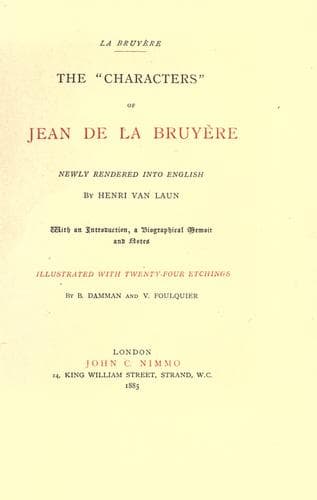
The "Characters" of Jean de La BruyèreLa Bruyère, Jean de
General
The "Characters" of Jean de La Bruyère
La Bruyère, Jean de
Character sketches -- Early works to 1800; Characters and characteristics
(20.) Have you any intelligence, grandeur of mind, capacity, taste,
sound judgment? Can I believe prejudice and flattery which so boldly
proclaim your merit? No! I suspect and reject them. I will not be
dazzled by that look of capacity and grandeur which makes it appear
as if you could act, speak, and write better than any one else; which
makes you so niggardly of bestowing praise, and renders it impossible
to obtain the smallest approbation from you. Hence I naturally infer
that you are a favourite, have influence, and are very wealthy. How
shall we describe you, Telephon?[455] We can only approach you as we do
fire, namely, from a certain distance; and to form an opinion of you
in a sensible and rational manner, we ought to strip you, handle you,
and confront you with your equals. Your confidant, your most intimate
friend, who gives you advice, for whom you give up the society of
Socrates and Aristides, with whom you laugh, and who laughs louder than
yourself, Davus,[456] in short, I know thoroughly; and this is enough
for me to make you out.
(21.) There are some persons who, if they did know their inferiors and
themselves, would be ashamed to be above them.
(22.) If there are but few excellent orators, are there many who
can understand them? If good writers are scarce, are there many who
can read? Thus we are always complaining of the paucity of persons
qualified to counsel kings, and assist them in the administration
of affairs; but if such able and intelligent personages make their
appearance, and act according to their ideas and knowledge, are they
beloved and esteemed as much as they deserve? Are they commended for
what they plan and do for their country? They exist, that is all; they
are censured if they fail, and envied if they succeed. Let us then
blame the people for whom it would be ridiculous to find an excuse. The
great and those in power look on their dissatisfaction and jealousy as
inevitable; and, for this reason, they have been gradually induced not
to take into account and to neglect their opinions in whatever they
undertake, and even to consider this a rule in politics.
The common people hate one another for the injuries they reciprocally
do each other; the great are execrated by them for all the harm they
do, and for all the good they do not, whilst they are also blamed for
their obscurity, poverty, and misfortunes.
Public-domain text, read in full here on John Shaqi.
Reviews
Reviews
No reviews yet
Be the first to share your thoughts on this work.
Elsewhere in the archive
Join the Discussion
Join the discussion
Sign in to leave a comment or review.
Sign InorCreate an account