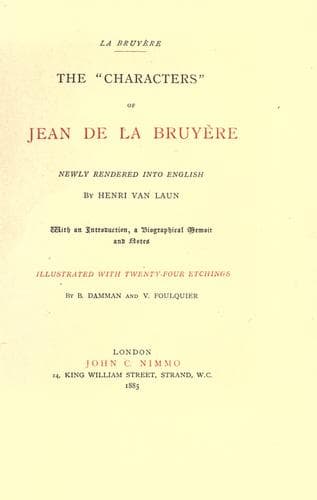
The "Characters" of Jean de La BruyèreLa Bruyère, Jean de
General
The "Characters" of Jean de La Bruyère
La Bruyère, Jean de
Character sketches -- Early works to 1800; Characters and characteristics
(26.) However able the great at court may be, and whatever skill they
may possess in appearing what they are not, and in not appearing what
they are, they cannot conceal their malice and their inclination to
make fun of other people, and often to render a person ridiculous who
is not really so. These fine talents are discovered in them at the
first glance, and are admirable without doubt to ensnare a dupe or
make a fool of a man who already was one, but are still better suited
to deprive them of the pleasure they might receive from a person of
intelligence, who knows how to vary and adapt his conversation in a
thousand agreeable and pleasant ways, and would do so, if the dangerous
inclination of a courtier to ridicule any one did not induce him to be
very reserved; he, therefore, assumes a grave air, and so effectively
entrenches himself behind it, that the jokers, ill disposed as they
are, cannot find an opportunity of making fun of him.
(27.) Ease, affluence, and a smooth and prosperous career are the cause
why princes can take some delight in laughing at a dwarf, a monkey, an
imbecile, or a wretched story; men less fortunate never laugh but when
they ought to.
(28.) A great man loves champagne and hates wine from La Brie; he gets
intoxicated with better wine than a man of the people; and this is the
only difference between orgies in the two most opposite conditions of
life, that of a lord and of a footman.
(29.) It would seem, at the first glance, that the pleasures of princes
always are a little seasoned with the pleasure of inconveniencing other
people. But this is not so; princes are like other men; they only
think of themselves, and follow their own inclinations, passions, and
convenience, which is quite natural.
(30.) One would think that the first rule of companies, of people in
office and in power, is to provide those who depend on them in their
business with as many obstructions as they dread those dependants might
place in their way.
(31.) I cannot imagine in what a great man is happier than others,
except perhaps in having more often the power as well as the
opportunity of rendering a service; and if such an opportunity occurs,
it seems to me that by all means he ought to embrace it. If it is for
an honest man, he should be afraid of letting it slip; but as it is
right to act thus, he should forestall any solicitation, and not be
seen until thanks are due to him for his success: if it is an easy
thing to render such a service, he should not set any value on it; if
he refuses to assist this honest man, I pity them both.
Public-domain text, read in full here on John Shaqi.
Reviews
Reviews
No reviews yet
Be the first to share your thoughts on this work.
Elsewhere in the archive
Join the Discussion
Join the discussion
Sign in to leave a comment or review.
Sign InorCreate an account