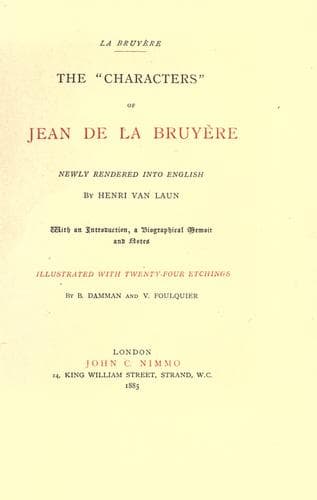
The "Characters" of Jean de La BruyèreLa Bruyère, Jean de
General
The "Characters" of Jean de La Bruyère
La Bruyère, Jean de
Character sketches -- Early works to 1800; Characters and characteristics
(23.) The great think it too much condescension to have the same
religion and the same God as the common people, for how can they be
called Peter, John, or James, as any tradesman or labourer? Let us
avoid, they say, to have anything in common with the multitude; let
us affect, on the contrary, a distinction which may separate us from
them; the people are welcome to the twelve apostles, their disciples,
and the first martyrs, fit patrons for such folks; let them every
year rejoice on some saintʼs day, which each celebrates as if it were
his birthday;[457] but for us great people, let us have recourse to
profane names, and be baptized by such patronymics as Hannibal, Cæsar,
and Pompey, for they were indeed great men; by that of Lucretia, for
she was an illustrious Roman lady; or by those of Rinaldo, Rogero,
Oliviero, and Tancredo,[458] who were paladins and among the most
marvellous heroes of romance; by those of Hector, Achilles, or
Hercules, all demi-gods: even by those of Phœbus and Diana; and who
shall prevent us from calling ourselves Jupiter, Mercury, Venus, or
Adonis?[459]
(24.) While the great neglect to become acquainted not only with the
interests of their princes and with public affairs, but with their
own, while they ignore how to govern a household or a family, boast of
this very ignorance, and are impoverished and ruled by their agents,
while they are satisfied with being dainty in eating and drinking,[460]
with visiting Thais and Phryne,[461] talking of various packs of
hounds, telling how many stages there are between Paris and Besançon or
Philipsburg,[462] some citizens instruct themselves in what is going
on within and without the kingdom, study the art of government, become
shrewd politicians, are acquainted with the strength and weakness of an
entire state, think of bettering their position, obtain a place, rise,
become powerful, and relieve their prince of a portion of the cares
of state. The great, who disdained them, now respect them, and think
themselves fortunate in being accepted as their sons-in-law.[463]
(25.) If I compare the two most opposite conditions of men, I mean
the great and the common people, the latter appear satisfied if they
only have the necessities of life, and the former fretful and poor
amidst superfluities. A man of the people can do no harm; a great man
will do no good, and is capable of doing great mischief; the first
only plans and practises useful things, the second adds to them what
is hurtful. Here rusticity and frankness show themselves ingenuously;
there a malignant and corrupt disposition lies hidden under a veneer
of politeness. If the common people have scarcely any culture, the
great have no soul; the first have a good foundation and no outward
appearances; the latter are all outward appearance and but a mere
superstratum. Were I to choose between the two, I should select,
without hesitation, being a plebeian.
Public-domain text, read in full here on John Shaqi.
Reviews
Reviews
No reviews yet
Be the first to share your thoughts on this work.
Elsewhere in the archive
Join the Discussion
Join the discussion
Sign in to leave a comment or review.
Sign InorCreate an account