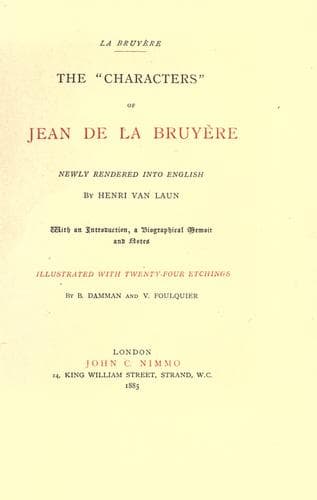
The "Characters" of Jean de La BruyèreLa Bruyère, Jean de
General
The "Characters" of Jean de La Bruyère
La Bruyère, Jean de
Character sketches -- Early works to 1800; Characters and characteristics
say simply, “The King has a great many enemies; they are powerful,
united, and exasperated; he has conquered them, and I hope he will
always do so.” This style, too bold and decisive for Demophilus, is not
sufficiently pompous or grandiloquent for Basilides; his head is full
of other expressions; he is planning inscriptions for triumphal arches
and pyramids to adorn the capital when the conqueror will enter it; and
as soon as he hears that the armies are in sight of each other, or that
a town is invested, he has his clothes hung out and aired, so that they
should be ready when a _Te Deum_ is sung in the cathedral.[504]
(12.) A business which has to be discussed by the plenipotentiaries or
by the diplomatic agents of crowned heads and republics must needs be
unusually intricate and difficult if its conclusion requires a longer
time than the settling of the preliminaries, nay, even than the mere
regulating of ranks, precedences, and other ceremonies.
A minister or a plenipotentiary is a chameleon or a Proteus;[505]
sometimes, like a practised gambler, he hides his temper and character,
either to avoid any conjectures or guesses, or to prevent any part of
his secret escaping through passion or weakness; and at other times
he knows how to assume any character most suited to his designs, or
which is required, as it may be his interest artfully to appear to
other people as they think he really is. Thus when he intends to
conceal that his master is very formidable or very weak, he is resolute
and inflexible to prevent any large demands; or he is easygoing,
so as to give others an opportunity of making some demands, and so
secure the same liberty. At other times he is either diplomatic and
disingenuous, so as to veil a truth whilst telling it, because it is of
some importance to him to have it divulged but not believed; or else he
is free and open, so that when he wishes to conceal what should not be
known, people should nevertheless believe that he is acquainted with
everything they wish to know, and be convinced that they have been told
everything. In like manner he is fluent and verbose to excite others
to talk, or prevent their saying what he does not wish or ought not to
hear; to speak of many and various things which modify and destroy each
other, and leave the mind hovering between confidence and distrust;
to make amends for an expedient thoughtlessly proposed by suggesting
another; or he is sedate and taciturn to induce others to talk, to
listen for a long time, so that he may afterwards obtain the same
favour himself, speak with authority and weight, and utter promises or
threats which will influence people and produce a strong impression.
He begins and speaks first, the better to discover the opposition and
contradictions, the intrigues and cabals, of foreign ministers about
some proposals he has made, to take his measures and reply to them; and
at another meeting he speaks last, that he may be sure not to speak
Public-domain text, read in full here on John Shaqi.
Reviews
Reviews
No reviews yet
Be the first to share your thoughts on this work.
Elsewhere in the archive
Join the Discussion
Join the discussion
Sign in to leave a comment or review.
Sign InorCreate an account