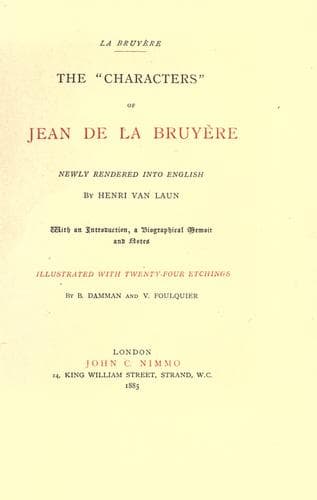
The "Characters" of Jean de La BruyèreLa Bruyère, Jean de
General
The "Characters" of Jean de La Bruyère
La Bruyère, Jean de
Character sketches -- Early works to 1800; Characters and characteristics
in vain, and to be exact, so as perfectly to be aware on what support
he can reckon for his master and his allies, as well as to know what
he ought to ask and what he can get. He knows how to be clear and
explicit, or still better, how to be ambiguous and obscure, and to use
words and phrases with a double meaning, which he can render more or
less forcible as the occasion or his interest may require. He asks for
a little because he will not grant much; he asks for much to make sure
of a little. At first he insists upon getting a few trifling things,
which he afterwards pretends to be of small value, so as not to prevent
him for asking for one of greater value; he avoids, on the contrary, to
gain at first an important point, if it is likely to prevent him from
obtaining several others of less importance, but which, when united,
exceed the other in value. His demands are extravagant, but he knows
beforehand they will be denied, so he is provided with a convenient
excuse for refusing those he knows will be made, and which he does
not wish to grant; as industrious to aggravate the enormity of these
demands, and to let his adversaries admit, if possible, that there
may be reasons why they cannot agree, as to weaken those which they
pretend to have for not granting him what he solicits so urgently;
and as diligent in vaunting and in enlarging upon the little he has
to offer as he is in despising openly the little they are willing to
grant. He pretends to make some extraordinary proposals which beget
distrust, and cause to be rejected what indeed, if accepted, could not
be performed; this also serves to colour his exorbitant demands, and
throws on his antagonists the responsibility of a refusal. He grants
more than is asked, so as to get still more than he gives. You have to
pray, entreat, and beseech him for a long time to obtain some trifling
favour, so as to destroy all expectations and uproot all thoughts of
asking anything more important of him; or, if he is persuaded to grant
it, it is always on such conditions that he may share in its profits
and advantages. He directly or indirectly espouses the interest of an
ally, if he finds it at the same time conducive to the advancing of
his own pretensions; he talks of nothing but peace and alliances, the
public tranquillity and the public interests, and thinks, indeed, only
of his own, or rather of his masterʼs and the Stateʼs he represents.
Sometimes he reconciles some people who were opposed to one another,
and sometimes he divides those who were united; he intimidates the
powerful and encourages the weak; he draws several weak States into a
league against a more powerful one, under the pretence of a balance of
power, and then joins the former to turn the scale; but his protection
and his alliance are always expensive. He knows how to interest those
with whom he treats, and by a dexterous management and by shrewd and
subtle subterfuges he makes them perceive what private advantage,
Public-domain text, read in full here on John Shaqi.
Reviews
Reviews
No reviews yet
Be the first to share your thoughts on this work.
Elsewhere in the archive
Join the Discussion
Join the discussion
Sign in to leave a comment or review.
Sign InorCreate an account