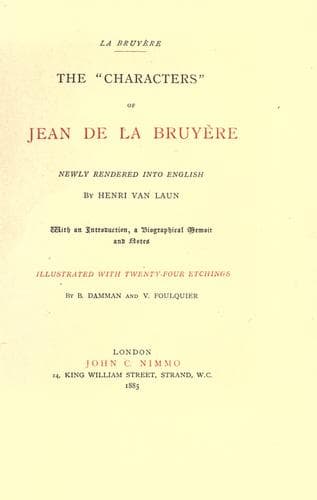
The "Characters" of Jean de La BruyèreLa Bruyère, Jean de
General
The "Characters" of Jean de La Bruyère
La Bruyère, Jean de
Character sketches -- Early works to 1800; Characters and characteristics
profits, and honours they may derive through a certain pliability,
which does not in the least clash with their instructions nor with the
intentions of their masters. And in order not to be thought impregnable
on his side, he betrays some anxiety to better his fortunes, and then
receives some proposals which unveil to him the most secret intentions,
the most profound designs, and the last resource of his opponents,
and which he turns to his own advantage. If sometimes he is a loser
by certain stipulations, which have at last been settled, he clamours
loudly; and if he is not, he is still louder, and puts the losers on
their justification and defence. His court has laid down rules of
conduct for his guidance, all his measures are preconcerted, and his
smallest advances arranged beforehand; and yet, whilst subjects of the
greatest difficulty are treated and certain points are most strenuously
contested, he behaves as if his yielding was voluntary, unexpected,
and purely a condescension on his part; he dares even pledge his word
that a certain proposal will be approved of, and that his master will
not disavow his proceedings; he allows false reports to be spread
concerning his instructions, which are represented as very limited,
but he knows he has some private instructions which he never discloses
until obliged to do so, and when it would damage him not to bring them
forward. All his intrigues aim at something solid and substantial,
for which he always is ready to sacrifice punctilios and imaginary
points of honour. He possesses a great deal of coolness, is armed with
courage and patience, and wearies and discourages others, but is never
weary himself! He takes precautions and is hardened against all delays
and procrastination, against all reproaches, suspicions, mistrust,
difficulties, and obstacles, convinced that time and circumstances
will influence the minds of his opponents, and accomplish the desired
end. He goes so far as to pretend he has a secret purpose in breaking
off the negotiations, while he passionately desires their continuance;
but, on the contrary, when he has strict orders to do his utmost to
break them off, he thinks the best way to effect it is to urge they
should be continued and speedily despatched. If some important event
happens, he affects either haughtiness or affability, as it may be to
his advantage or prejudice; and if he is so perspicacious as to foresee
it, he hurries it on or temporises according as the state for whom he
labours dreads or desires it, and acts according to these emergencies.
He shapes his actions to suit time, place, and opportunities, his own
strength or weakness, the genius of the nation he has to deal with, and
the mood and character of the personages with whom he is negotiating.
All his designs and maxims, all the devices of his policy, tend only to
prevent his being deceived, and to deceive others.[506]
(13.) The French nation require their sovereign to be grave in his
deportment.[507]
Public-domain text, read in full here on John Shaqi.
Reviews
Reviews
No reviews yet
Be the first to share your thoughts on this work.
Elsewhere in the archive
Join the Discussion
Join the discussion
Sign in to leave a comment or review.
Sign InorCreate an account