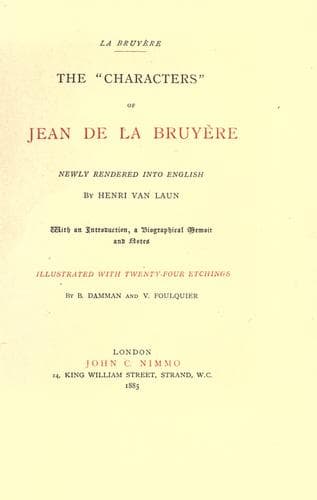
The "Characters" of Jean de La BruyèreLa Bruyère, Jean de
General
The "Characters" of Jean de La Bruyère
La Bruyère, Jean de
Character sketches -- Early works to 1800; Characters and characteristics
be absolute, to leave no room for indirect influence, intrigues and
factions, and sometimes to lessen that vast distance which exists
between the great and the common people, so that they may be drawn
closer together, and obey that power equally; the knowledge of the
prince should be extensive, that he may see everything with his own
eyes, act immediately and by himself, so that his generals, though
at a distance, are but his lieutenants, and his ministers but his
ministers;[530] he should be sagacious enough to know when to declare
war, when to conquer and make the best use of a victory, when to make
peace, and when to break it; when, sometimes, to compel his enemies to
accept it, according to the various interests at stake; to set bounds
to his vast ambition, and how far to extend his conquests; he should
find leisure for games, festivals, and spectacles; cultivate arts and
sciences, and erect magnificent structures, even when surrounded by
secret and declared enemies. To conclude, he should possess a superior
and commanding genius, which renders him beloved by his subjects and
feared by strangers, and makes of his court, and even of his entire
realm, as it were, one family, governed by one head, living in perfect
unison and harmony with one another, and thus formidable to the rest
of the world. All these admirable virtues seem to me comprised in the
notion of what a sovereign ought to be. It is true we rarely see them
all combined in one man, for too many adventitious qualities, such as
intelligence, feelings, outward appearances, and natural disposition,
must be found at the same time in him; it therefore appears to me that
a prince who unites all these in his single person well deserves the
name of Great.[531]
[Illustration: LOUIS XIV]
[Illustration]
XI.
OF MANKIND.
(1.) Let us not be angry with men when we see them cruel, ungrateful,
unjust, proud, egotists, and forgetful of others; they are made so; it
is their nature; we might just as well quarrel with a stone for falling
to the ground, or with a fire when the flames ascend.
(2.) In one sense men are not fickle, or only in trifles; they change
their habits, language, outward appearance, their rules of propriety,
and sometimes their taste; but they always preserve their bad morals,
and adhere tenaciously to what is ill and to their indifference for
virtue.
Public-domain text, read in full here on John Shaqi.
Reviews
Reviews
No reviews yet
Be the first to share your thoughts on this work.
Elsewhere in the archive
Join the Discussion
Join the discussion
Sign in to leave a comment or review.
Sign InorCreate an account