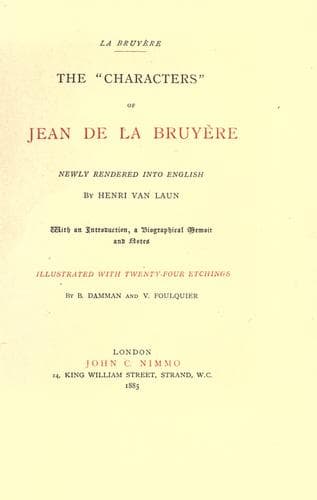
The "Characters" of Jean de La BruyèreLa Bruyère, Jean de
General
The "Characters" of Jean de La Bruyère
La Bruyère, Jean de
Character sketches -- Early works to 1800; Characters and characteristics
(3.) Stoicism is a mere fancy, a fiction, like Platoʼs Republic.
The Stoics pretend a man may laugh at poverty; not feel insults,
ingratitude, loss of property, relatives, and friends; look
unconcernedly on death, and regard it as a matter of indifference which
ought neither to make him merry nor melancholy; not let pleasure or
pain conquer him; be wounded or burned without breathing the slightest
sigh or shedding a single tear; and this phantasm of courage and
imaginary firmness they are pleased to call a philosopher. They have
left man with the same faults they found in him, and did not blame
his smallest foible. Instead of depicting vice as something terrible
or ridiculous, which might have corrected him, they have limned an
idea of perfection and heroism of which man is not capable, and they
exhorted him to aim at what is impossible. Thus, the philosopher that
is to be, but will never exist except in imagination, finds himself
naturally, and without any exertions of his own, above all events and
all ills; the most excruciating fit of the gout, the most severe attack
of colic, cannot draw from him the least complaint; Heaven and earth
may be overturned, without dragging him along in their downfall; and
he remains calm and collected amidst the ruins of the universe, whilst
a man really beside himself utters loud exclamations, despairs, looks
fierce, and is in an agony for the loss of a dog or for a China dish
broken into pieces.
(4.) Restlessness of mind, inequality of temper, fickleness of
affections, and instability of conduct, are all vices of the mind,
but they are all different; and, in spite[532] of their appearing
analogous, are not always found in one and the same subject.
(5.) It is difficult to decide whether irresolution makes a man more
unfortunate than contemptible, or even whether it is always a greater
disadvantage to take a wrong step than to take none at all.
(6.) A man of variable mind is not one man, but several men in one; he
multiplies himself as often as he changes his taste and manners; he is
not this minute what he was the last, and will not be the next what he
is now; he is his own successor. Do not ask what is his nature, but
what are his proclivities; nor what mood he is in, but how many sorts
of moods he has. Are you not mistaken, and is it Eutichrates whom you
accost? To-day he is cool to you, but yesterday he was anxious to see
you, and was so demonstrative that his friends were jealous of you.
Surely he does not remember you; tell him your name.
Public-domain text, read in full here on John Shaqi.
Reviews
Reviews
No reviews yet
Be the first to share your thoughts on this work.
Elsewhere in the archive
Join the Discussion
Join the discussion
Sign in to leave a comment or review.
Sign InorCreate an account