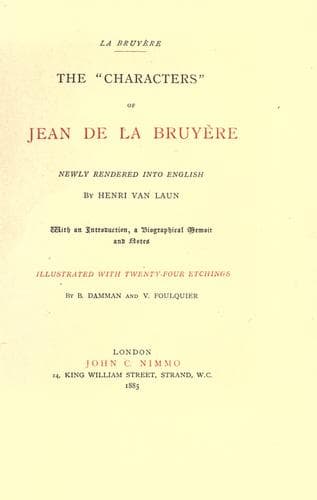
The "Characters" of Jean de La BruyèreLa Bruyère, Jean de
General
The "Characters" of Jean de La Bruyère
La Bruyère, Jean de
Character sketches -- Early works to 1800; Characters and characteristics
“what can he be doing? what has become of him? Let him never more
present himself before me; I discharge him this very minute!” The
servant makes his appearance, and he asks him, in a contemptuous tone,
where he comes from; the man replies he has been where he was sent
to, and gives a faithful account of his errand. You would often take
Menalcas for what he is not, for an idiot; for he does not listen,
and speaks still less; for a madman, because he talks to himself, and
indulges in certain grimaces and involuntary motions of the head;
for proud and discourteous, because when you bow to him, he may pass
without looking at you, or look at you and not return your bow; for a
man without any feeling, for he talks of bankruptcy in a family where
there is such a blot; of executions and the scaffold before a person
whose father has been beheaded; of plebeians before plebeians who
have become rich and pretend to be of noble birth. He even intends
to bring up his illegitimate son in his house, and pretends he is a
servant; and though he would have his wife and children know nothing
about the matter, he cannot forbear calling him his son every hour of
the day. He resolves to let his son marry the daughter of some man of
business, yet he now and then boasts of his birth and ancestors, and
that no Menalcas has ever made a misalliance. In short, he seems to be
absent minded, and to pay no attention to the conversation going on; he
thinks and speaks at the same time, but what he says is seldom about
what he thinks; so that there is hardly any coherence and sequence in
his talk; he often says “yes” when he should say “no,” and when he
says “no,” you must suppose he would say “yes.” When he answers you so
pertinently, his eyes are fixed on your countenance, but it does not
follow that he sees you; he looks neither at you nor at any one, nor at
anything in the world. All that you can draw from him, even when he is
most sociable and most attentive, are some such words as these: “Yes,
indeed; it is true; very well; really; indeed; I believe so; certainly;
O Heaven!” and some other monosyllables, even not always used on
the right occasions. He never is with those with whom he appears to
be; he calls his footman very seriously “Sir,” and his friend “La
Verdure;”[547] says “Your Reverence” to a prince of the royal blood,
and “Your Highness” to a Jesuit. When he is at mass, and the priest
sneezes, he cries out aloud, “God bless you!” He is in the company
of a magistrate of serious disposition, and venerable by his age and
dignity, who asks him whether a certain event happened in such and such
a way, and Menalcas replies, “Yes, miss.” As he came one day from the
country, his footmen plotted to rob him and succeeded; they jumped down
from behind his coach, presented the end of a torch to his breast, and
demanded his purse, which he gave up.[548] When he came home he told
his friends what had happened, and when they asked for details he said
Public-domain text, read in full here on John Shaqi.
Reviews
Reviews
No reviews yet
Be the first to share your thoughts on this work.
Elsewhere in the archive
Join the Discussion
Join the discussion
Sign in to leave a comment or review.
Sign InorCreate an account