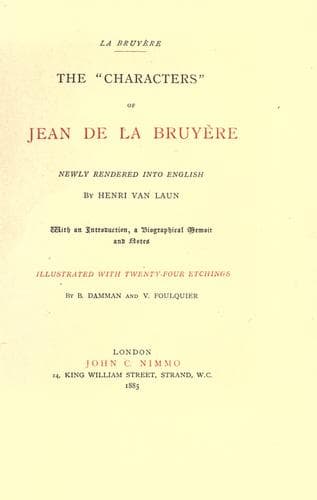
The "Characters" of Jean de La BruyèreLa Bruyère, Jean de
General
The "Characters" of Jean de La Bruyère
La Bruyère, Jean de
Character sketches -- Early works to 1800; Characters and characteristics
they had better inquire of his servants, who also were present.
(8.) Impoliteness is not a vice of the mind, but the consequence of
several vices; of foolish vanity, of ignorance of oneʼs duties, of
idleness, of stupidity, of absence of mind, of contempt for others, and
of jealousy. Though it only shows itself outwardly, it is not the less
odious, because it is a fault which is always visible and manifest;
however, it gives more or less offence, according as the motives for
displaying it are more or less offensive.
(9.) If we say of an angry, captious, quarrelsome, melancholy, formal,
capricious person, that it is all owing to his temper, it is not to
find an excuse for him, whatever people may think, but an involuntary
acknowledgment that such great faults admit of no remedy.
What we call good temper is a thing too much neglected among men; they
ought to understand that they should not alone be good, but also appear
to be so, at least if they are inclined to be sociable and disposed to
friendly intercourse; in other words, if they would be men. We do not
require wicked men to be gentle and urbane; in these qualities they
are never wanting, for they employ them to ensnare the simple, and to
find a larger field for their operations; but we wish kind-hearted men
always to be tractable, accessible, and courteous; so that there should
no longer be any reason for saying that wicked men do harm and that
good men make others uncomfortable.
(10.) The generality of men proceed from anger to insults; others act
differently, for they first give offence and then grow angry; our
surprise at such behaviour always supersedes resentment.
(11.) Men do not sufficiently take advantage of every opportunity for
pleasing other people. When a person accepts a certain post, it seems
that he intends to acquire the power of obliging others without using
it; nothing is quicker and more readily given than a refusal, whilst
nothing is ever granted until after mature reflection.
(12.) Know exactly what you are to expect from men in general, and
from each of them in particular, and then mix with the people around
you.
(13.) If poverty is the mother of all crimes, lack of intelligence is
their father.
(14.) A knave can hardly be a very intelligent man; a clear and
far-seeing mind leads to regularity, honesty, and virtue; it is want
of sense and penetration which begets obstinacy in wickedness as well
as in duplicity; in vain we endeavour to correct such a man by satire;
it may describe him to others, but he himself will not know his own
picture; it is like scolding a deaf man. It would be well, please
gentlemen of sense and culture, and avenge everybody, if a rogue were
not so constituted as to be without any feeling whatever.
Public-domain text, read in full here on John Shaqi.
Reviews
Reviews
No reviews yet
Be the first to share your thoughts on this work.
Elsewhere in the archive
Join the Discussion
Join the discussion
Sign in to leave a comment or review.
Sign InorCreate an account