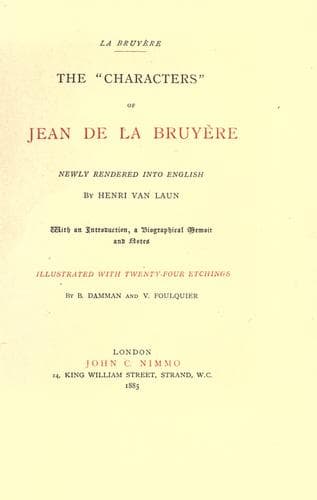
The "Characters" of Jean de La BruyèreLa Bruyère, Jean de
General
The "Characters" of Jean de La Bruyère
La Bruyère, Jean de
Character sketches -- Early works to 1800; Characters and characteristics
(15.) There are some vices for which we are indebted to none but
ourselves, which are innate in us, and are strengthened by habit; there
are others we contract which are foreign to us. Sometimes men are
naturally inclined to yield without much difficulty, to be urbane, and
to desire to please; but by the treatment they meet from those whom
they frequent and on whom they depend, they soon lose all moderation,
and even change their disposition; they grow melancholy and peevish to
a degree ere this unknown to them; their temper is completely changed,
and they are themselves astonished at their being rude and tetchy.
(16.) Some people ask why the whole bulk of mankind does not
constitute one nation, and does not like to speak the same language,
obey the same laws, and agree among themselves to adopt the same
customs and the same worship? For my part, observing how greatly
minds, tastes, and sentiments differ, I am astonished to see seven or
eight persons, living under the same roof and within the same walls,
constitute one family.[549]
(17.) There are some extraordinary fathers, who seem, during the whole
course of their lives, to be preparing reasons for their children for
being consoled at their deaths.[550]
(18.) Everything is strange in the dispositions, morals, and
manners of men: one person who during his whole lifetime has been
melancholy, passionate, avaricious, fawning, submissive, laborious,
and egotistical, was born lively, peaceable, indolent, ostentatious,
and with lofty feelings, abhorring anything base; want, circumstances,
and dire necessity have compelled him and caused such a great change.
Such a manʼs inmost feelings can really not be described, for too many
external things have altered, changed, and upset him, so that he is not
exactly what he thinks he is himself or what he appears to be.
(19.) Life is short and tedious, and is wholly spent in wishing; we
trust to find rest and enjoyment at some future time, often at an age
when our best blessings, youth and health, have already left us. When
at last that time has arrived, it surprises us in the midst of fresh
desires; we have got no farther when we are attacked by a fever which
kills us; if we had been cured, it would only have been to give us more
time for other desires.
(20.) A man requesting a favour from another, surrenders himself at
discretion to the personage from whom he expects it, but when he is
quite sure it will be granted, he temporises, parleys, and capitulates.
(21.) It is so usual for men not to be happy, and so essential for
every blessing to be acquired with infinite trouble, that what is
obtained easily is looked upon with suspicion. We can hardly understand
how anything which costs us so little can be greatly to our advantage,
or how by strictly honest means we can so easily obtain what we want;
we may think we deserve our success, but we ought very seldom to depend
on it.
Public-domain text, read in full here on John Shaqi.
Reviews
Reviews
No reviews yet
Be the first to share your thoughts on this work.
Elsewhere in the archive
Join the Discussion
Join the discussion
Sign in to leave a comment or review.
Sign InorCreate an account