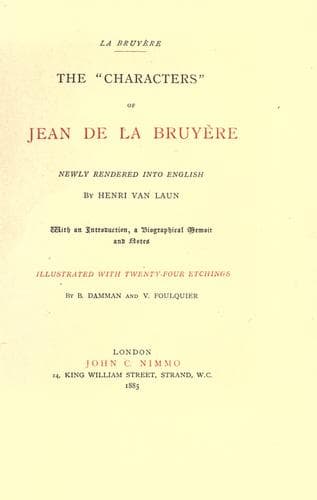
The "Characters" of Jean de La BruyèreLa Bruyère, Jean de
General
The "Characters" of Jean de La Bruyère
La Bruyère, Jean de
Character sketches -- Early works to 1800; Characters and characteristics
(45.) Humanly speaking, there is something good in death, namely, that
it puts an end to old age. That death which prevents decrepitude comes
more seasonably than that which ends it.
(46.) Men regret their life has been ill-spent, but this does not
always induce them to make a better use of the time they have yet to
live.
(47.) Life is a kind of sleep; old men have slept longer than others,
and only begin to wake again when they are to die. If, then, they
take a retrospect of the whole course of their lives, they frequently
discover neither virtues nor commendable actions to distinguish one
year from another; they confound one time of their life with another
time, and see nothing of sufficient note by which to measure how long
they have lived. They have dreamt in a confused, indistinct, and
incoherent way; but, nevertheless, they are aware, as all people who
wake up, that they have slept for a long while.
(48.) There are but three events which concern man: birth, life, and
death. They are unconscious of their birth, they suffer when they die,
and they neglect to live.
(49.) There is a time preceding the power of reasoning, when, like
animals, we live by instinct alone, and of which memory retains no
vestiges. There is a second period, when reason is developed, formed,
and might act, if it were not obscured and partly extinguished by vices
of the constitution, and a sequence of passions following one another
till the third and last age; reason then, being in its full strength,
should produce something; but it is chilled and impaired by years,
disease, and sorrow, and rendered useless by the machinery getting old
and out of gear; yet these three periods constitute the whole life of
man.
(50.) Children are overbearing, supercilious, passionate, envious,
inquisitive, egotistical, idle, fickle, timid, intemperate, liars, and
dissemblers; they laugh and weep easily, are excessive in their joys
and sorrows, and that about the most trifling objects; they bear no
pain, but like to inflict it on others; already they are men.
(51.) Children are neither for the past nor the future, but enjoy the
present, which we rarely do.
(52.) There seems to be but one character in childhood; at that age
morals and manners are nearly all the same, and it is only by paying
great attention that we can perceive any difference, which, however,
increases in the same proportion as reason does, whilst the passions
and vices gather strength as well; these alone make men so unlike each
other and so at variance with themselves.
Public-domain text, read in full here on John Shaqi.
Reviews
Reviews
No reviews yet
Be the first to share your thoughts on this work.
Elsewhere in the archive
Join the Discussion
Join the discussion
Sign in to leave a comment or review.
Sign InorCreate an account