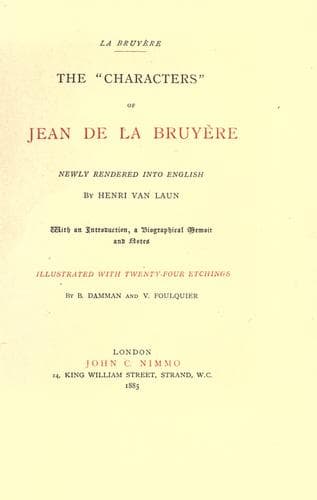
The "Characters" of Jean de La BruyèreLa Bruyère, Jean de
General
The "Characters" of Jean de La Bruyère
La Bruyère, Jean de
Character sketches -- Early works to 1800; Characters and characteristics
(67.) Men speak of themselves in such a manner, that though they admit
they are guilty of some trifling faults, these very faults imply
noble talents or great qualities. Thus they complain of a bad memory,
though quite satisfied with the large amount of common sense and
sound judgment they possess; submit to being reproached for absence
of mind and musing, imagining them the concomitants of intelligence;
acknowledge being awkward and not able to do anything with their hands,
and comfort themselves for being without these small qualities by the
knowledge of possessing those of the understanding or those innate
feelings which every one allows them. In owning their indolence they
always intimate they are disinterested and entirely cured of ambition;
they are not ashamed of being slovenly, which shows they merely are
careless of little things, and seems to imply that they solely occupy
themselves with solid and important matters. A military man affects
to say that it was rashness or curiosity which carried him into the
trenches on a certain day, or in a dangerous spot, without being on
duty or ordered to do so; and he adds that the general reprimanded him
for it. Thus a man possessing brains or a solid genius and an innate
circumspection which other men endeavour in vain to acquire; a man who
has strengthened his mind by a long experience; to whom the number,
weight, variety, difficulty, and importance of affairs merely procure
some occupation without embarrassing him; who, by his extensive
knowledge and penetration masters all events; who does not consult all
the remarks ever written on the art of governments and politics, but
is, perhaps, one of those sublime minds created to sway others, and
from whose example those rules were first made; who is diverted, by
the great things he does, from those pleasant and agreeable things he
might read, and who, on the contrary, loses nothing by recapitulating
and turning over, as it were, his own life and actions: a man, so
constituted, may easily, and without compromising himself, admit that
he knows nothing of books and never reads.[556]
(68.) Men intend sometimes to conceal their imperfections, or attenuate
the opinion of others about them, by frankly acknowledging them. “I am
very ignorant,” says some man who knows nothing; “I am getting old,”
says a second above threescore; “I am far from rich,” says a third who
is wretchedly poor.
(69.) There is either no such thing as modesty, or it is mistaken for
something quite different, if we think it to be an inward sentiment,
debasing man in his own eyes, and which is a supernatural virtue we
call humility. Man naturally thinks of himself with pride and conceit,
and thinks thus of no one but himself; modesty only aims at modifying
this disposition so that no one shall suffer by it; it is an external
virtue, which commands our looks, gait, words, tone of voice, and
obliges a man ostensibly to act with others as if in reality he did not
despise them.
Public-domain text, read in full here on John Shaqi.
Reviews
Reviews
No reviews yet
Be the first to share your thoughts on this work.
Elsewhere in the archive
Join the Discussion
Join the discussion
Sign in to leave a comment or review.
Sign InorCreate an account