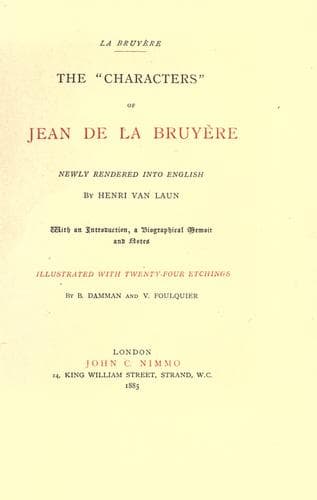
The "Characters" of Jean de La BruyèreLa Bruyère, Jean de
General
The "Characters" of Jean de La Bruyère
La Bruyère, Jean de
Character sketches -- Early works to 1800; Characters and characteristics
(58.) Who can doubt but that children conceive, judge, and reason
consistently? If only in small things consider they are children, and
without much experience; if they make use of an indifferent phraseology
it is less their fault than their parentsʼ and mastersʼ.
(59.) It destroys all confidence in the minds of children, and
alienates them as well, to punish them for faults they have not
committed, or even to be severe with them for trifling offences; they
know exactly, and better than any one, what they deserve, and seldom
deserve more than they dread; when they are chastised, they know if it
is justly or unjustly, whilst unjust punishments do them more harm than
not to be punished at all.
(60.) Man does not live long enough to be benefited by his faults; he
is committing them during the whole course of his life, and it is as
much as he can do, if, after many errors, he dies at last improved.
Nothing revives more a man than the knowledge that he has avoided doing
some foolish action.
(61.) Men are loath to particularise their faults; they conceal them
or blame some other person for them, and this gives the “spiritual
director”[554] an advantage over the father-confessor.
(62.) The faults of blockheads are sometimes so great and so difficult
to foresee, that wise men are puzzled by them; they are only of use to
those who commit them.
(63.) A party spirit betrays the greatest men to act as meanly as the
vulgar herd.
(64.) Vanity and propriety lead us to act in the same way and in the
same manner as we should do through inclination or a feeling of duty; a
man died lately in Paris of a fever which he got by sitting up at night
with his wife, for whom he did not care.[555]
(65.) All men in their hearts covet esteem, but are loath any one
should discover their anxiety to be esteemed; for men wish to be
considered virtuous; and men would no longer be thought virtuous, but
fond of esteem and praises, and vain, were they to derive any other
advantages from virtue than virtue itself. Men are very vain, and of
all things hate to be thought so.
(66.) A vain man finds it to his advantage to speak well or ill of
himself; a modest man never talks of himself.
We cannot better understand how ridiculous vanity is, and what a
disgraceful vice it is, than by observing how careful it is not to be
seen, and how often it hides itself underneath a semblance of modesty.
False modesty is the highest affectation of vanity; it never shows
a vain man in his true colours, but, on the contrary, enhances his
reputation, through the very virtue which is the opposite of the vice
constituting his real character; it is a falsehood. False glory is the
rock on which vanity splits; it induces a desire in men to be esteemed
for things they indeed possess, but which are frivolous and unworthy of
being noticed; it is an error.
Public-domain text, read in full here on John Shaqi.
Reviews
Reviews
No reviews yet
Be the first to share your thoughts on this work.
Elsewhere in the archive
Join the Discussion
Join the discussion
Sign in to leave a comment or review.
Sign InorCreate an account