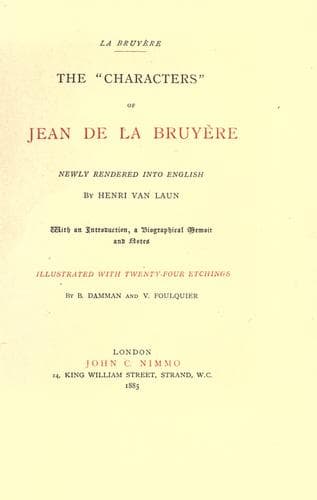
The "Characters" of Jean de La BruyèreLa Bruyère, Jean de
General
The "Characters" of Jean de La Bruyère
La Bruyère, Jean de
Character sketches -- Early works to 1800; Characters and characteristics
An intelligent man is not jealous of a cutler who has made a first-rate
sword, nor of a sculptor who has just finished a fine piece of
statuary; he knows there are rules and methods in those arts beyond his
ken; that tools have to be handled with which he is unacquainted, and
of whose very names and shapes he is ignorant; it is sufficient for him
to be aware that he has never served an apprenticeship to such a trade,
and he consoles himself, therefore, that he has not mastered them. But
he may, on the contrary, envy, and even be jealous of a minister of
state, and of those who govern; as if reason and common sense, of which
he has a share as well as they have, are the only things required for
ruling a nation and for the administration of public affairs, and as if
they could take the place of regulations, directions, and experience.
(86.) We meet with few utterly dull and stupid men, but with fewer
sublime and transcendental ones. The generality of mankind hovers
between these two extremes; the gap is filled by a great number of
men of ordinary talents, but who are very useful and serviceable to
the State, and efficient as well as agreeable; as, for example, in
commerce, finances, during war, in navigation, arts, trades, in the
possession of a good memory, in gambling,[558] in society, and in
conversation.
(87.) All the intelligence of the world is useless to a man who has
none, for having no ideas himself, he cannot be improved by those of
others.
(88.) To feel the want of reasoning faculties is the next thing to
possessing them; a madman cannot have this sensation. Thus the next
best thing to intelligence is the consciousness that we have none,
for then we might do what is considered impossible, and, without
intelligence, neither be a fool nor a fop nor impertinent.
(89.) A man who has not a large amount of intelligence is grave and all
of a piece; he does not laugh, he never jokes nor trifles; and is as
incapable of rising to great things as of suiting himself, by way of
change, to small ones; he hardly knows how to play with his children.
(90.) Everybody says of a coxcomb that he is a coxcomb, but no one
dares to tell him so; he dies without knowing it and without anybody
being avenged on him.
(91.) What a dissonance is there between the mind and the heart! Some
philosophers lead bad lives though they have large stores of “wise
saws;” and some politicians, full of schemes and ideas, cannot govern
themselves.
(92.) The mind wears out like other things; sciences are its aliment;
they nourish it and wear it out.
(93.) Men of inferior rank are sometimes burdened with a thousand
useless virtues, but they have no opportunities of making use of them.
Public-domain text, read in full here on John Shaqi.
Reviews
Reviews
No reviews yet
Be the first to share your thoughts on this work.
Elsewhere in the archive
Join the Discussion
Join the discussion
Sign in to leave a comment or review.
Sign InorCreate an account